
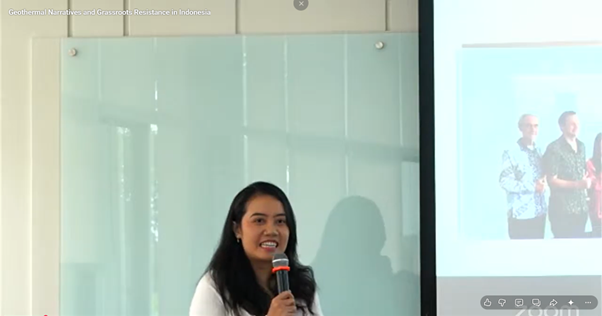
The Study Program of Religious and Cross-cultural Studies (ALB) or the Center for Religious and Cross-cultural Studies (CRCS), Graduate School of Universitas Gadjah Mada (SPs UGM), held its Wednesday Forum on Wednesday, April 22nd 2026, at the Graduate School Building, UGM Unit 1. The event served as an open academic forum featuring interdisciplinary discussions on social, cultural, environmental issues, and global justice.
CRCS UGM invited Martha Hesty Susilowati as the speaker. She is a professional and researcher with more than a decade of experience in psychology, gender equality, and social sciences. Her career bridges academic inquiry and field-based work, focusing on gender issues, community-based interventions, decolonial frameworks, and indigenous knowledge systems. She currently serves as a Gender & Social Inclusion Consultant with extensive experience in participatory research, comprehensive assessments, and safeguarding policy development for international non-governmental organizations and energy companies. Her research portfolio includes peer-reviewed publications and conference presentations that critically engage with social science and women’s studies.
Martha Hesty Susilowati, in her presentation, delivered a talk titled “Geothermal Narratives and Grassroots Resistance in Indonesia: Decolonial Frameworks for Energy Transitions and Environmental Justice.” The study examines green energy narratives used by groups opposing geothermal development in Indonesia and how these narratives are constructed and articulated within community-based social movements.
She explained that debates on energy transition are not only technical and policy-driven, but also rooted in how human–nature relations are understood. A decolonial perspective is used to examine the extent to which energy transitions reinforce or challenge power relations that commodify nature while marginalizing affected communities. This approach also enriches social movement theory by incorporating the experiences and narratives of Indigenous Peoples and local communities.
The research involved community-based researchers in 14 locations affected by geothermal projects, who collaborated in data collection and reflection. The findings reveal contrasting narratives between energy coloniality and decoloniality across six key dimensions: definitions of green energy, environmental impacts, ownership of green energy policies, socio-cultural aspects, national development policies, and local development priorities. The study also showed that resistance movements reflect decolonial praxis in rethinking energy and justice relations.
The discussion further highlighted how global geopolitical tensions, including dynamics in the Strait of Hormuz, are accelerating the transition toward alternative energy sources such as geothermal. However, this raises critical questions about who truly benefitted from the discourse of “green energy.”
“Energy transition should not be seen merely as a technical agenda, but as a political space where power relations, knowledge systems, and social justice are contested,” stated Martha Hesty Susilowati.
The forum encouraged participants to understand that energy issues are not solely about technology and sustainability, but also about social justice, power relations, and how humans interpret their relationship with nature. The event was open to the public and provided a critical dialogue space for academics, students, and the wider community.
Author: Asti Rahmaningrum