
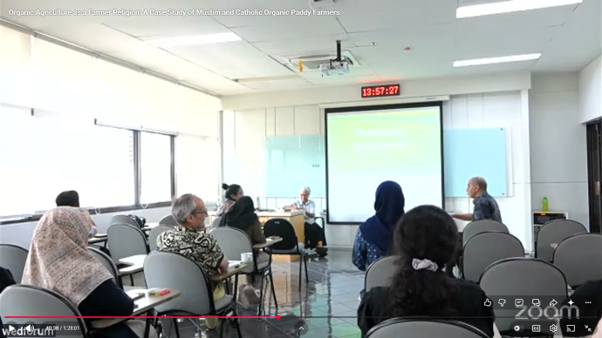
The Program Studi Agama dan Lintas Budaya (Center for Religious and Cross-cultural Studies, Graduate School of Universitas Gadjah Mada / CRCS UGM) held its Wednesday Forum on May 6th 2026. This event is a regular academic program that serves as a platform for interdisciplinary discussion on issues related to religion, culture, and society.
CRCS UGM, on this occasion, invited Fransisca Yohana Sri Winarsih as speaker. She is a Catholic nun of the Faithful Companions of Jesus, an educator, and an interdisciplinary scholar in religious studies. She is also a graduate of the Doctoral Program in Interreligious Studies (IRS), Graduate School of Universitas Gadjah Mada, with research interests in ecological spirituality, moral philosophy, and interreligious studies.
Fransisca, in her presentation, discussed her research on Muslim and Catholic organic rice farming communities in Central Java and the Special Region of Yogyakarta. She emphasized that organic farming is not merely understood as a technical agricultural practice, but also as a way of life aligned with religious worldviews that see nature as a divine creation with order and purpose.
According to her, this way of life produces a set of symbolic meanings, including transcendence, ritual practices, teachings, materiality, and shared emotional experiences among interfaith farmers. “For farmers, organic agriculture is not just a method of cultivation, but a way of life that shapes ecological and spiritual awareness,” she said.
Based on her findings, Fransisca proposed the concept of “farmer religion” as a theoretical framework. Drawing on Robert Bellah’s idea of civil religion, this concept is seen as a shared space that can strengthen social cohesion in multicultural and multireligious societies.
She further explained that in the context of environmental crisis and religious diversity, “farmer religion” can serve as a meeting point for Muslim and Catholic farmers to work together in caring for the Earth. This concept does not replace formal religions, but instead draws from the values embedded within each religious tradition.
Author: Asti Rahmaningrum