
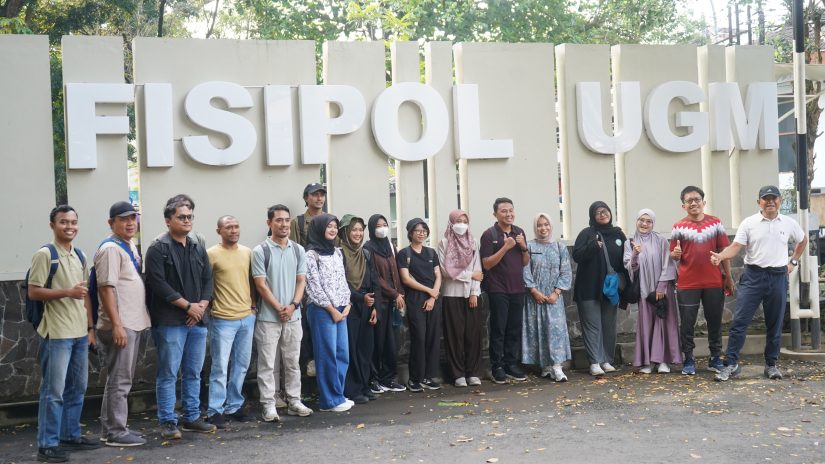

Students of the Environmental Science Master’s Program at the Graduate School of Universitas Gadjah Mada (SPs UGM) carried out a series of field studies and field lectures in April 2026 as part of strengthening practice-based learning. These activities took place in three different locations: the Code River area in Yogyakarta, the Song Terus Site and karst landscape in Pacitan, and the Bompon area in Magelang.
The first activity, titled Code River Field Study in Yogyakarta, was conducted on April 6th 2026. Students engaged in direct learning along the Code Riverbanks to explore environmental management in densely populated urban areas. The main focus included settlement spatial planning, sanitation systems, and the socio-ecological dynamics of communities living near the river.
The guidance from Prof. Bakti Setiawan shows environmental management principles were understood not only as technical arrangements but also as forms of social, economic, and spatial engineering embodied in the local principle of 3M: Mundur (move back), Munggah (elevate), and Madhep Kali (face the river). Students learned that social capital—such as community bonds, networks, and relationships with formal institutions—is key to sustaining basic services like communal sanitation, wastewater treatment (IPAL), and community-based clean water provision amid challenges of legality and formal–informal sector disparities.
This experience was further deepened with a field lecture on April 11th 2026, at the Song Terus Cave Site and Museum in Pacitan. The karst landscape and archaeological remains highlighted the close relationship of physical environmental dynamics and the evolution of human culture from a geo-ecological perspective. Guided by lecturers in Cultural Environment, students examined artifacts, laboratories, and conservation spaces to understand how scientific knowledge, cultural heritage, and prehistoric site preservation are integrated within the framework of quality education and sustainable city–community development.
The series of field learning activities was completed with an exploration of the Bompon area in Magelang on April 18th 2026. The total of 14 students, accompanied by Prof. Junun Sartohadi, studied soil formation processes, hydrothermal alteration phenomena, and chronic landslide risks as a basis for designing productive conservation strategies adaptive to geomorphological dynamics. The direct observation showed students to gain deeper insight into sustainable land management strategies, including efforts to mitigate land degradation and adapt to environmental change.
Overall, these three field activities reaffirmed the relevant environmental research and management do not always rely on grand theories, but rather begin with immediate, real-world issues that are developed into empirical learning to support the achievement of the Sustainable Development Goals (SDGs).
Author: Siti Muyasaroh