
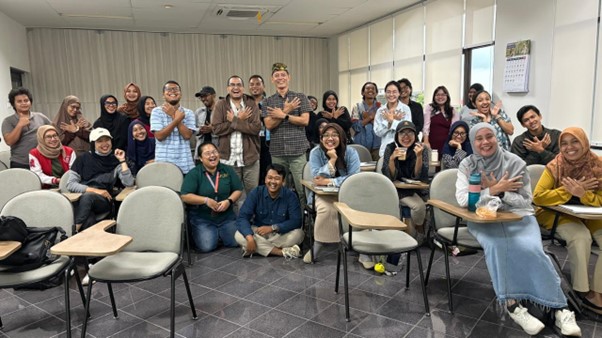
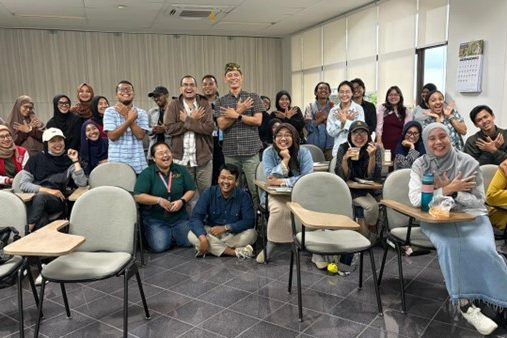
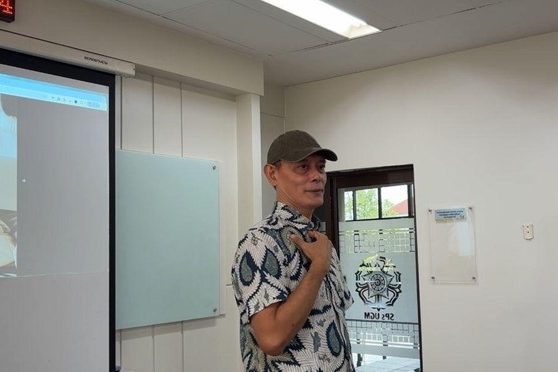
The Media and Cultural Studies Master’s Program (KBM), Graduate School of Universitas Gadjah Mada, organized a Discussion Series under the theme Branding and Promotional Culture titled “Branding the Faith” on Wednesday and Thursday, April 29th–30th 2026. The event took place in Room 307, 3rd Floor, Graduate School Building Unit 1, and featured Dr. Leonard Chrysostomos Epafras as the keynote speaker.
This activity was part of the learning enrichment for the course Branding and Promotional Culture, and also served as an academic forum that brings together perspectives from cultural studies, media studies, and contemporary religious dynamics. Over the course of two days, the sessions were attended by graduate students and participants from diverse academic backgrounds with an interest in religion and popular culture.
On the first day, Wednesday (April 29), Dr. Leonard Chrysostomos Epafras delivered a session titled “Branding and the Commodification of Spirituality.” The discussion began with a participatory approach encouraging active engagement from the audience. This interactive opening set the tone for exploring how religion and spirituality are increasingly shaped by media logic and market mechanisms.
The speaker, in his presentation, invited participants to critically reflect on the definition of religion by raising fundamental questions about what constitutes religion and what does not. He emphasized that religion can no longer be understood solely as a transcendental or institutional entity, but must also be seen as a social phenomenon embedded within media capitalism. In this context, religious practices and spirituality often appear in forms similar to products—complete with identity, differentiation, and efforts to build emotional connections with their “audiences.”
The discussion also highlighted how spiritual expressions are undergoing processes of commodification. The perceiving values are as purely inward or sacred experiences, packaged and disseminated on various media, following patterns of production and consumption typical of cultural industries. This shift reflects changing ways in which religion is practiced and interpreted in contemporary society.
The second session, held on Thursday (April 30th), continued with the topic “The Politics of Religious Marketing.” The speaker opened with an analogy of furoshiki wrap, a traditional Japanese art of wrapping, emphasizing that presentation can be just as important as content. This analogy illustrated how representation, symbolism, and modes of delivery play crucial roles in attracting public attention, including within religious contexts.
The discussion then moved toward the concept of commodification, particularly when exchange value begins to dominate use value. In the case of religion, this can be observed in how religious symbols, practices, and narratives are produced in ways that make them measurable, exchangeable, and marketable. The speaker also connected this phenomenon to the concept of reification, where abstract ideas such as belief systems or social relations are transformed into seemingly tangible objects.
The session also addressed the increasingly blurred boundaries of the sacred and the secular. Religious practices are now adopting branding and marketing strategies, while secular sectors often employ approaches resembling preaching or missionary work to cultivate loyal audiences. This convergence demonstrates how previously distinct domains are now intertwined and mutually influential.
The concluding note shows the discussion introducing the concept of techno-feudalism to explain the growing dominance of major technology companies in today’s digital ecosystem. Digital platforms function not only as channels of distribution but also as structures that shape how messages—including religious ones—are produced, circulated, and consumed. In this context, religious institutions, as well as individuals, are compelled to adapt to the dynamics of media capitalism in order to remain relevant.
The Media and Cultural Studies Master’s Program (KBM), with this Discussion Series reaffirming its role as a critical academic space that responds to contemporary issues. The two-day event not only broadened participants’ perspectives but also encouraged deeper reflection on the position of religion within the evolving landscape of culture, media, and global economic systems.
Author: Khoirul Mujazanah