
The Study Program of Religious and Cross-cultural Studies (ALB) or the Center for Religious and Cross-cultural Studies (CRCS), Graduate School of Universitas Gadjah Mada (SPs UGM), held Wednesday Forum on Wednesday, April 29th 2026, at the Graduate School Building, UGM Unit 1.
CRCS UGM, on this occasion,featured Farabi Fakih as the speaker. He is a historian and lecturer at the Department of History, Faculty of Cultural Sciences, Universitas Gadjah Mada. He earned his Ph.D. in 2014 with a dissertation titled “The Rise of the Managerial State in Indonesia: Institutional Transition during the Early Independence Period, 1950–1965.” His academic work covers environmental history, locality, and historical ontology, employing an interdisciplinary approach to contemporary historiographical studies.
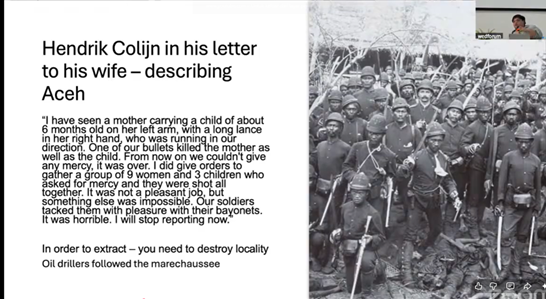
Farabi Fakih, in his presentation, discussed the geographical production of the Outer Java region in the early 20th century in relation to the development of the colonial oil industry. The Dutch East Indies at that time was one of the world’s largest oil producers, dominated by Royal Dutch Shell until the early 1940s. He emphasized that oil extraction was not merely a technological and economic process, but was also closely related to the formation of spatial configurations and colonial power structures.
Farabi also explained that from the late 19th to early 20th century, Dutch imperial expansion in the Outer Islands (buitenbezittingen or buitengewesten) was shaped through the involvement of colonial oil agents within the framework of the Ethical Policy. These agents functioned as global resource managers who contributed to the creation of geographical and political inequalities of Java and the Outer Islands as part of a colonial extractive strategy. This process also contributed to the formation of colonial administrative structures in these regions.
He also highlighted various debates and controversies in both the Netherlands and Java regarding the alleged “theft” of oil by Royal Dutch Shell and two American oil companies, namely Standard of New Jersey and Standard of California, which also operated in the Dutch East Indies. These debates shaped discourses on oil resource management and its relation to the geographical construction of Java and the Outer Islands—discourses that continue to influence Indonesia’s post-independence spatial structure.
In his remarks, Farabi Fakih stated, “The oil industry during the colonial period not only shaped the global economy but also produced spatial inequalities whose legacies remain visible today.”
The forum carried the theme “Before petroleum fueled the world, it fractured the archipelago”highlighted how the emergence of the colonial oil industry contributed to the production of spatial inequality in the Indonesian archipelago. The Outer Islands were not only constructed as resource extraction zones but were also politically produced through colonial policies, imperial concessions, and global competition over resource control.
Participants, with this event, were expected to gain a deeper understanding of the interconnections between global capitalism, the oil industry, and the legacy of colonial fragmentation in shaping spatial relations in modern Indonesia.
Author: Asti Rahmaningrum