
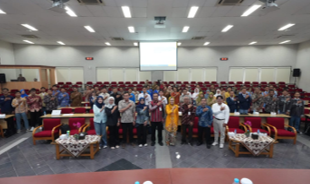
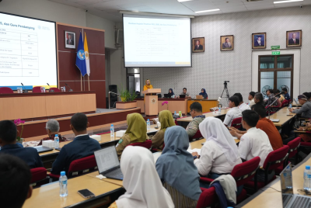
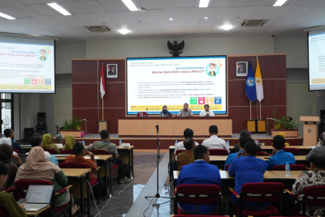
Gadjah Mada (UGM), after providing training for teachers on a Traffic Education program based on the Massive Open Online Course (MOOC) platform, UGM continued the implementation of the program by involving students as the primary participants. A total of 62 students, consisting of representatives from School Security Patrols (PKS) and Student Councils (OSIS) from 31 junior high schools, senior high schools, and vocational high schools of the Special Region of Yogyakarta, participated in the MOOC-Based Traffic Education Training held on May 21st–22nd, 2026, at the 5th Floor Auditorium of the UGM Graduate School.
Each school sent one PKS member and one OSIS representative accompanied by a supervising teacher. These teachers had previously participated in the MOOC-Basic Traffic Education Training for Teachers organized by the UGM Community Service Team. Through this initiative, the implementation of traffic education in schools is expected to become more effective with collaboration between teachers and students.
The program was initiated by Prof. Ir. Siti Malkhamah and the UGM Community Service Team, with support from the Yogyakarta Special Region Education Quality Assurance Center (BPMP), the Center for Teachers and Education Personnel Development (BBGTK), the Directorate of Academic Studies and Innovation of UGM, and several education offices throughout the Special Region of Yogyakarta.
The representative from the Yogyakarta Regional Office of Education, Youth, and Sports, in her remarks, expressed appreciation for the program. The involvement of students as the main participants was considered an important step in fostering a culture of traffic safety from an early age. Meanwhile, Prof. Siti Malkhamah emphasized that education is one of the strategic efforts to reduce traffic accidents and promote safer road-user behavior.
This program is also aligned with Indonesia’s National Road Traffic and Transportation Safety Plan (RUNK LLAJ) 2022, which identifies improving road safety literacy as a key strategy for reducing traffic accidents. The utilization of the MOOC platform, learning materials can be accessed more broadly, flexibly, and sustainably by students.
On the first day, participants were introduced to the objectives of the program, the concept of MOOC-based learning, and the use of the UGM Online platform. In addition to receiving explanations about the learning materials, participants also engaged in hands-on practice using the platform on their own devices. Students learned how to access the platform, log in, navigate learning modules, watch instructional videos, access reading materials, and complete quizzes available in each module. This activity aimed to enhance students’ understanding of road safety and to provide them with practical experience in using digital learning platforms that they could later utilize independently in their respective schools.
Following a pre-test, students participated in learning sessions with modules developed by the UGM team. Each session was complemented by discussions and question-and-answer sessions with lecturers and community service team members to deepen participants’ understanding of road safety.
Throughout the two-day program, the student studied various aspects of traffic safety, including traffic ethics, pedestrian and cyclist safety, motorcycle riding safety, and the role of young people in fostering a culture of road safety. At the end of the program, participants completed a post-test as part of the learning evaluation process to measure improvements in their understanding after completing all training activities.
On the second day, the program continued with additional sessions delivered by BPMP and BBGTK of the Special Region of Yogyakarta. Participants also attended presentations and experience-sharing sessions from schools that had piloted the implementation of MOOC-Based Traffic Education, namely SMA Negeri 1 Yogyakarta and SMP Muhammadiyah 2 Yogyakarta. The participants gained practical insights into program implementation at schools, challenges encountered, and strategies for increasing student participation.
Based on the evaluation results, most students responded positively to the materials delivered with the MOOC platform. Topics related to traffic signs and road markings attracted the greatest interest, as they will make students understand information better, which they frequently encountered on the road but had not fully comprehended before. In addition, materials on pedestrian safety, safe road-crossing practices, motorcycle and bicycle safety, and traffic regulations at intersections and traffic lights were considered highly relevant to daily life.
Participants also appreciated the use of videos, animations, and interactive quizzes, which made the learning process more engaging, easier to understand, and encouraged active participation throughout the training. The pre-test and post-test results indicated an improvement in participants’ understanding, suggesting that the MOOC-based learning approach has strong potential as an effective traffic safety education medium for students.
The program also included discussion sessions, evaluations, and the preparation of follow-up action plans involving students, supervising teachers, and the community service team. These forums provided opportunities for participants to share feedback and formulate implementation strategies for traffic education programs in their respective schools after the training concluded.
Participants, as PKS members and student council leaders, are expected to become pioneers of traffic safety in their schools. The selection of PKS and OSIS members was based on their strategic roles within the school environment. As organizations closely connected to student activities and school discipline, PKS and OSIS are expected to serve as agents of change by disseminating traffic safety messages among their peers and supporting the sustainable implementation of traffic education programs.
This initiative also represents UGM’s contribution to achieve the Sustainable Development Goals (SDGs). Through road safety education, the program contributes to SDG 3 (Good Health and Well-Being) by reducing traffic accident risks, SDG 4 (Quality Education) by providing access to quality and inclusive learning, and SDG 11 (Sustainable Cities and Communities) by promoting a safe and sustainable traffic culture.
The involvement of PKS members made student council representatives, supervising teachers, and schools, UGM hopes that MOOC-based traffic education will continue to be implemented sustainably. In doing so, the knowledge and awareness of traffic safety gained during the training can be disseminated to more students and contribute positively to creating a safer traffic culture within schools and the broader community.
Author: Nanda
Editor: Arfika