
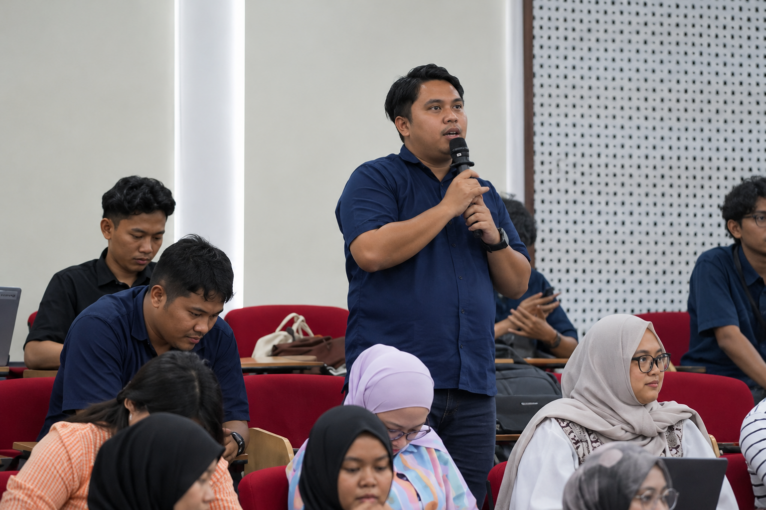
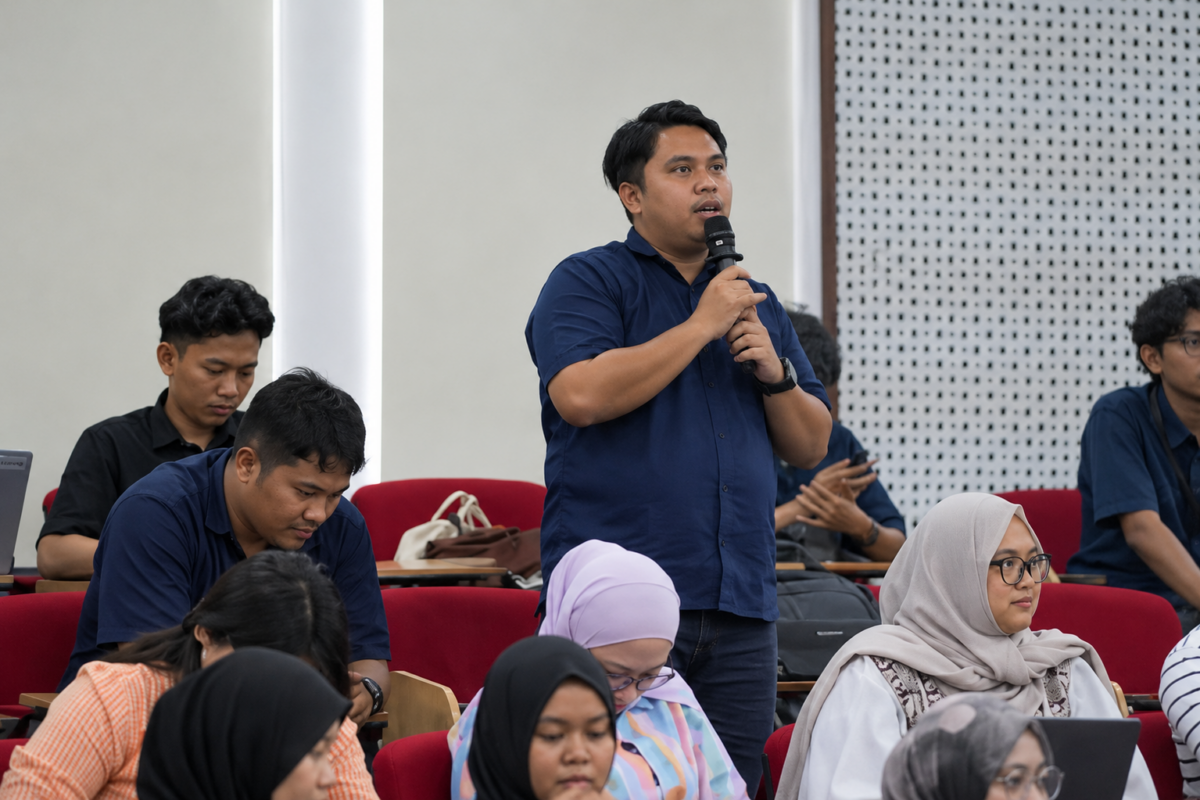
The Graduate School of Universitas Gadjah Mada (SPs UGM) held the Scientific Writing Workshop as part of its regular activities to support the development of students’ academic competencies. It was held for two day.T the workshop was officially opened by the Dean of the Graduate School of UGM, Prof. Ir. Siti Malkhamah, M.Sc., Ph.D., on Wednesday, August 26th at the 5th Floor Auditorium of the Graduate School of UGM. The workshop was attended by approximately 200 master and doctoral students from various study programs at SPs UGM.
Prof. Siti Malkhamah’s remarks emphasized that scientific writing as an important competency for graduate students. Scientific works are expected to demonstrate quality in terms of substance and also to adhere to academic conventions and the principles of academic integrity.
“This workshop is one of our efforts to enhance students’ ability to produce high-quality scientific works that comply with academic conventions and uphold integrity,” said Prof. Siti.
This year’s workshop, in addition to equipping students with scientific writing skills, also provided an opportunity to understand the latest developments in the use of Artificial Intelligence (AI) in scientific writing. The development of AI technology offers various opportunities to support academic activities; however, its use needs to be approached wisely and responsibly while upholding academic ethics.
The workshop began with a session entitled “Current Developments and Challenges of AI,” delivered by Dr. Irwan Endrayanto Aluicius, S.Si., M.Sc., from the Directorate of Academic Studies and Innovation at UGM. According to Dr. Irwan, the convenience offered by AI needs to be accompanied by a critical attitude on the part of its users. AI does not always produce accurate information; therefore, its outputs need to be checked and verified before being incorporated into scientific works. The quality of information generated by AI is also strongly influenced by the data and instructions provided to the system.
Therefore, critical thinking remains an essential skill for students when using AI. Technology can support the academic process, but decisions regarding the accuracy, relevance, and use of information ultimately remain the responsibility of the author.
The discussion continued with Plenary Session 1, “Tips for Successful Publication in Reputable Journals,” featuring Prof. Dr. Nurdiana Gaus, S.S., PGDip., Ph.D. as the speaker. The session provided students with insights into strategies for preparing scientific manuscripts to increase their chances of being accepted by reputable journals.
Scientific publication goes beyond the ability to produce well-written manuscripts. Students also need to understand the characteristics of their target journals, align their manuscripts with the journals’ standards and scope, and ensure that their research demonstrates a clear scientific contribution.
The issue of AI was further addressed in Plenary Session 2, “AI Use and Ethics,” delivered by Dr. Leonard Chrysostomos Epafras. The session highlighted the importance of understanding the ethical boundaries of AI use. Students remain responsible for their ideas, analytical processes, the accuracy of information, and the scientific works they produce. Therefore, AI should be positioned as a supporting tool, rather than a substitute for the author’s thinking process and academic responsibility.