
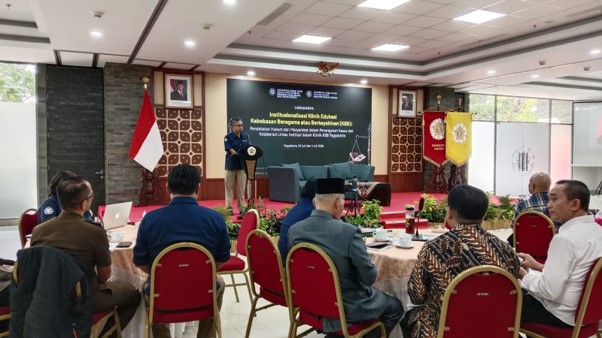
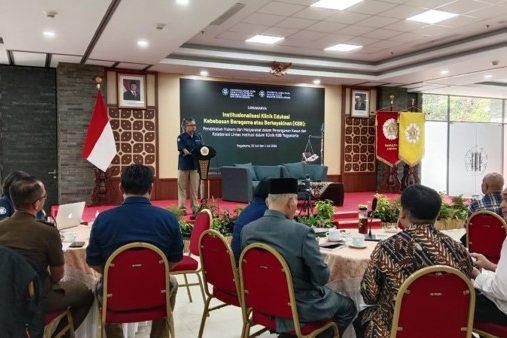
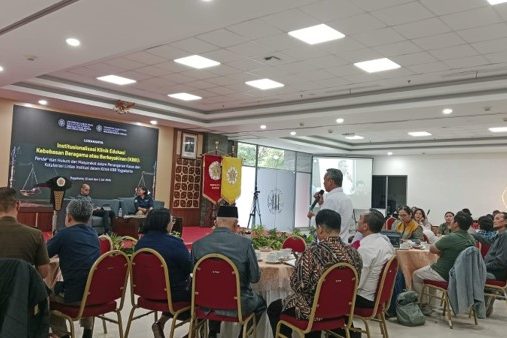
The Religion and Cross-Cultural Studies Master Program (CRCS) at the Graduate School of Universitas Gadjah Mada (UGM), in collaboration with the Litigation Law Master Program of UGM Faculty of Law and the Yogyakarta Freedom of Religion or Belief (FoRB) Clinic, organized a workshop entitled “Strengthening Understanding of the Intersectionality of Human Rights in Freedom of Religion or Belief (FoRB)” at the Auditorium of Building B, Faculty of Law UGM, on Wednesday (June 10).
The workshop marked the initial phase of the Institutionalization of the Collaborative Yogyakarta Freedom of Religion or Belief (FoRB) Education Clinic program. The initiative aims to strengthen synergy among academics, law enforcement agencies, government institutions, civil society organizations, and vulnerable communities in promoting the inclusive fulfillment of citizens’ rights.
The Dean of the UGM Graduate School, Prof. Siti Malkhamah, was represented by the Vice Dean for Finance, Assets, and Human Resources, Dr. techn. Khabib Mustofa, who delivered the opening remarks. In his speech, he emphasized the important role of higher education institutions as a space for dialogue and knowledge development that can contribute to addressing various social challenges, including issues related to freedom of religion or belief.
The workshop featured a number of academics and practitioners concerned with human rights and freedom of religion or belief. The first session, entitled “Freedom of Religion or Belief, Human Rights, and Society,” was delivered by Dr. Zainal Abidin Bagir. He discussed the position of freedom of religion or belief within the broader human rights framework and examined the dynamics of its implementation in Indonesia. The following session explored issues of intersectionality in FoRB, including its connections with gender, children’s rights, disability, and access to justice.
The workshop to strengthen participants’ conceptual understanding of freedom of religion or belief, also served as a forum for stakeholders to exchange experiences in case handling, preventing rights violations, and developing more effective collaborative strategies. Participants included representatives from government agencies, law enforcement institutions, academia, civil society organizations, and communities actively engaged in advocating for and advancing freedom of religion or belief rights.
Chief of the CRCS Master Program at UGM, Dr. M. Iqbal Ahnaf, explained that the workshop is part of a broader effort to develop a structured and sustainable collaborative working model through the Yogyakarta FoRB Clinic. Through a series of activities scheduled from June to July 2026, participants are expected to formulate joint operational guidelines to support case management, policy advocacy, and public education on issues related to freedom of religion or belief.
The UGM Graduate School with this workshop reaffirmed its commitment to contributing to the advancement of knowledge and strengthening cross-sector collaboration in support of an inclusive society that respects diversity and upholds the principles of human rights.
Author: Asti Rahmaningrum