

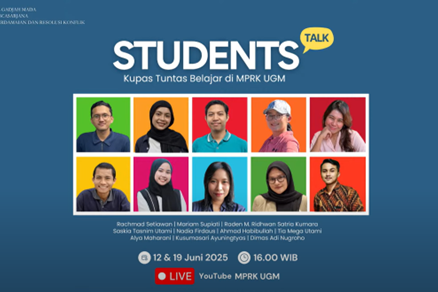


Yogyakarta, June 20th 2025 – The Peace and Conflict Resolution Master Program in (MPRK) at the Graduate School of Universitas Gadjah Mada (UGM) is more than academic space; it is a platform that changes perspectives and “humanizes” its students. This profound insight was revealed during an online talk show series titled “MPRK Talks”, held throughout June 2025.
In the discussion, broadcast live on YouTube, several active students from the 2024 cohort shared their experiences studying in this program, a pioneer in peace studies in Indonesia and Southeast Asia. They collectively described MPRK as a “welcoming home” with a highly supportive academic environment.
One of the main points is how MPRK successfully shifted the students’ initial expectations. Ahmad Habibullah, who has a background in International Relations, admitted that he initially hoped to delve into security from a military standpoint. However, at MPRK, he was introduced to the broader and more relevant concept of Human Security.
“My expectations shifted. Here, I am learning more about the social side of human security, and I am happy because I get to study its development,” said Ahmad. Alya Maharani, a student from Aceh, echoed this sentiment. Originally focused on interstate diplomacy,” she remarked, “Here I understand better that a peaceful diplomat isn’t always about dealing with nations. Conflict at the community level is also crucial.”
The students highlighted MPRK’s learning methods, which are highly applicable and far from being merely theoretical. This “hands-on experience” begins early in the program, where students are asked to conduct observations in their surroundings to understand issues in a real-world context.
“Conflict is all around us, even within ourselves,” said another student, Nadia. “Here, we are given the tools to think, to see how conflict can be guided towards a positive outcome, not just a brawl. We learn to manage it.”
This analytical skill was demonstrated when an audience member, Akbar Farid, presented a real-life case study about a water distribution conflict in his village. The students adeptly explained the MPRK approach. “First, we need to map out who is involved and their power relations. Then, find the root cause of the problem, whether it’s due to a lack of resources or a management issue,” they answered collectively.
MPRK’s strength as an interdisciplinary program proves to open new horizons and broad career prospects. Students come from various backgrounds, including International Relations, Islamic Family Law, State Administration, and Communication Science.
“Our alumni are everywhere. Some have become peacemakers in NGOs in Papua and Aceh, some are in government institutions like the Presidential Communication Office, and many have become academics,” explained Dimas, one of the speakers. Opportunities are also wide open in the corporate world for roles such as mediators or conflict consultants.
The flexibility of the class schedule is another added value, allowing students to work or have families to keep up with their studies without feeling overwhelmed.
In closing, one of the students, Ridwan, quoted a message from their lecturer, Prof. Mohtar, which served as a collective reflection. “Indonesia is a work in progress, so we must safe it together. One of the ways to do that is by studying at MPRK UGM,” he concluded, summarizing the program’s vision to shape agents of peace.
For prospective students, the MPRK UGM Program is currently accepting applications for the new intake until July 2nd 2025, with various scholarship pathways available, including LPDP, the Indonesian Education Scholarship (BPI), and Beasiswa Unggulan.
Author: Berlian Belasuni