
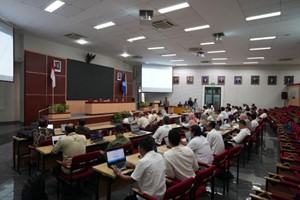
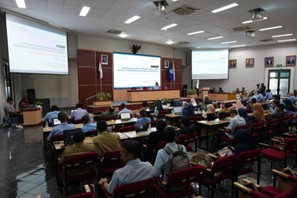
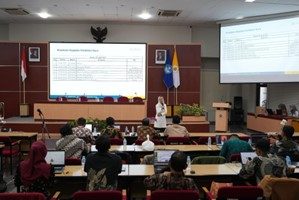
Universitas Gadjah Mada (UGM) continues its commitment in improving road safety with a teacher training program on Traffic Education based on the Massive Open Online Course (MOOC) platform. This activity aims to strengthen the role of teachers as facilitators in instilling a culture of safe road behavior among students.
The training focuses on the use of UGM’s digital learning platform, UGM Online, as the main medium. This platform introduces teachers to various interactive learning features such as videos, reading materials, and evaluation quizzes designed to enhance students’ understanding of road safety in a more engaging and effective way.
This program was initiated by Prof. Ir. Siti Malkhamah, M.Sc., Ph.D., IPU., ASEAN Eng., together with the UGM Community Service Team, and supported by several strategic partners, including the Education Quality Assurance Agency (BPMP) of the Special Region of Yogyakarta, the Center for Teachers and Education Personnel (BBGTK) of the Special Region of Yogyakarta, the Directorate of Academic Studies and Innovation (DKIA) UGM, and the Regional Education, Youth, and Sports Offices in the Special Region of Yogyakarta and related districts/cities. The training was attended by 62 teachers representing various junior high schools, senior high schools, and vocational schools in Yogyakarta.
Representatives from the education offices and BBGTK, in their remarks, expressed appreciation for the implementation of this MOOC-based Traffic Education teacher training. They emphasized that this training is essential in equipping teachers as facilitators in schools therefore the implementation of traffic safety education can run more optimally and sustainably. Meanwhile, Prof. Ir. Siti Malkhamah highlighted this program as a UGM response to the high number of traffic accidents through a technology-based educational approach.
The implementation of this program is also aligned with national policy directions in the National General Plan for Road Traffic and Transportation Safety (RUNK LLAJ) 2022. The plan emphasizes the improvement of safety capacity and literacy among road users is one of the main strategies to reduce traffic accidents. One of the key focuses of RUNK is strengthening the aspect of “safe road users” with education, provision of accessible learning materials, and the use of technology to expand the reach of traffic safety education. This MOOC-based is for teacher training. It is expected that the learning implementation can be optimized, thereby improving students’ understanding and awareness of road safety in a more effective and sustainable manner.
In this training, teachers are equipped with technical knowledge on implementing MOOC-based learning, ranging from accessing modules, managing learning flows, to conducting evaluations through pre-tests and post-tests provided in the system. Teachers are also encouraged to actively facilitate students and integrate the materials into co-curricular activities and the School Safety Patrol (PKS) program.
The training also includes discussion and Q&A sessions of teachers and lecturers, providing space for participants to deepen their understanding and share experiences. In addition, there are supplementary sessions delivered by BPMP and BBGTK to enrich participants’ insights in implementing learning at schools.
This activity also represents an important step by UGM in supporting the achievement of the Sustainable Development Goals (SDGs). Through road safety education, this initiative contributes to SDG 3 (Good Health and Well-Being) by reducing the risk of traffic accidents, and SDG 4 (Quality Education) by providing access to quality and inclusive learning for the community. Furthermore, it supports SDG 11 (Sustainable Cities and Communities) by promoting safe road behavior as part of building resilient and sustainable cities.
Through this training, UGM hopes that teachers can become agents of change in fostering road safety awareness among students. In the future, this program will continue to be developed through ongoing assistance to schools to ensure the optimal implementation of MOOC-based Traffic Education and to create a tangible impact on society.
Author: Nanda
Editor: Arfikah Istari