
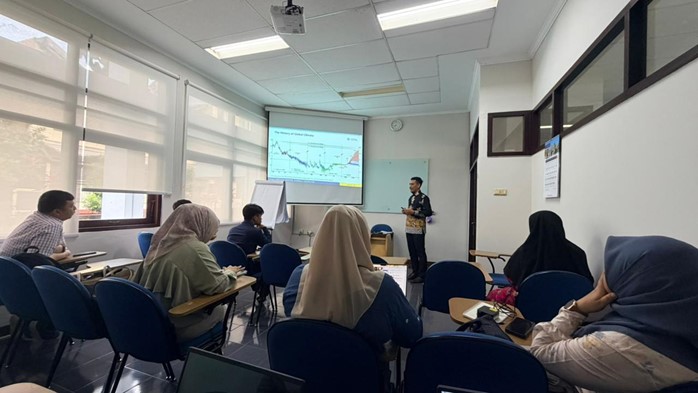
Amid the increasingly complex global environmental crisis, development can no longer be understood merely as a matter of economic growth. It must also take into account surrounding ecosystems to ensure the progress does not result in environmental degradation. This awareness emerged prominently in the guest lecture titled Environmental Bioethics and Sustainable Development, organized by the Bioethics Master’s Program on Thursday, February 26th 2026.
The session featured Dr. Priyaji Agung Pambudi. In this academic forum, one central message was strongly emphasized: “the environmental crisis is a moral crisis.” Addressing students of the Bioethics Master’s Program, he stressed the development policies that damage ecosystems cannot be separated from ethical choices. It was regarding how humans interpret their relationship with nature.
The discussion was grounded in the concept of sustainable development, which has long served as a global framework, including the Sustainable Development Goals (SDGs). These goals rest on three main pillars—economic, social, and environmental—yet in practice, they are often imbalanced. In this context, environmental bioethics serves as a reflective framework to assess whether a policy is truly just—not only for the present generation, but also for future generations.
Specifically, the guest lecture was closely related to SDG 12 (Responsible Consumption and Production), SDG 13 (Climate Action), SDG 15 (Life on Land), and SDG 16 (Peace, Justice, and Strong Institutions). These four goals will be difficult to achieve without a strong ethical foundation in natural resource management and development decision-making.
Various ethical principles—such as intergenerational justice, the intrinsic value of nature, and environmental justice—provide a basis for analyzing real-world conflicts. These include tensions of mining activities and community welfare, deforestation in the name of food security, renewable energy development that paradoxically damages habitats, and the relocation of Indigenous communities for national projects.
The lecture also framed the climate crisis as a global ethical challenge, requiring interdisciplinary approaches and the courage to question development paradigms that have long been considered established. As emphasized in the forum, bioethics is no longer confined to clinical or laboratory settings; rather, it has become an essential lens for responding to the world’s ecological crisis.
The event, with intensive and reflective discussions, created space for students to view environmental issues more critically—highlighting them not merely as technical or policy matters, but as fundamental questions of values, responsibility, and the sustainability of life itself.
Author: Fajar Saris
Editor: Yeti Susilowati