
Universitas Gadjah Mada (UGM) continues to promote the development of national resilience studies capability of responding to an increasingly complex global strategic environment. Indonesia needs not only a strong defense system, but also a knowledge ecosystem capable of generating adaptive strategic thinking and policies to address geopolitical, economic, socio-cultural, and technological challenges.
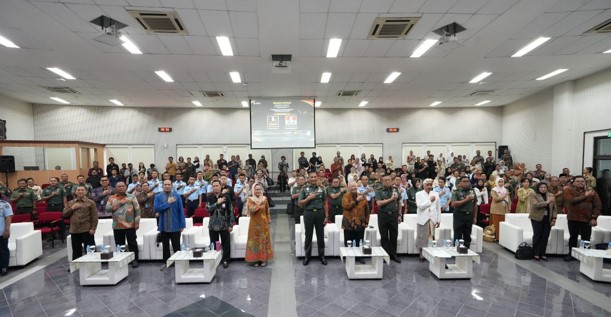
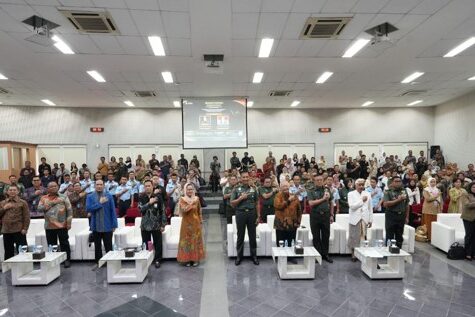
This was one of the main topics discussed at the National Seminar entitled “Building a Strategic National Resilience Knowledge Ecosystem to Strengthen the Glory of Greater Indonesia Toward the Second Century of Independence,” organized by the National Resilience Master and the Doctoral Program at the UGM Graduate School. The seminar was held on Monday, July 27th, at the UGM Graduate School Auditorium. It was attended by approximately 350 participants both in person and online, representing government institutions, the Indonesian Armed Forces (TNI), academics, and practitioners, to discuss the future direction of Indonesia’s National Resilience studies.
Dean of the UGM Graduate School Prof. Ir. Siti Malkhamah, M.Sc., Ph.D., IPU., ASEAN.Eng., opening the seminar, stated that the National Resilience Master and Doctoral Programs are expected to produce scholars capable of generating original ideas grounded in Pancasila, the Archipelagic Outlook (Wawasan Nusantara), and Indonesia’s geostrategic character. According to her, national resilience is a multidisciplinary field requiring cross-sectoral collaboration to build an adaptive and sustainable nation.
“National resilience is a multidisciplinary field,” she said. She expressed hope that the seminar would produce concrete recommendations for the future development of the National Resilience curriculum.
Sabrang Mowo Damar Panuluh, Expert Advisor to the National Defense Council of the Ministry of Defense of the Republic of Indonesia, the keynote speaker, encouraged academics to develop a more critical perspective on the concept of national resilience. According to him, universities provide a space to develop and test various concepts, including by reassessing what national interests genuinely need to be protected.
He emphasized that threats do not always come from abroad, but may also arise from an inability to understand the nation’s own identity. Therefore, threat mapping needs to begin with a comprehensive understanding of national identity and the interests that need to be safeguarded. He also noted that conflicts can essentially begin with differences in perception, making the ability to manage perceptions an important component of strengthening national resilience.
Development and tourism perspectives were also incorporated into this discussion of national resilience. During the strategic keynote session, Faisal, S.ST.Par., M.M.Par., CHE., Assistant Deputy for Human Resources Capacity Development in the Industrial Sector at the Ministry of Tourism of the Republic of Indonesia, explained that tourism development toward Golden Indonesia 2045 is directed toward developing high-quality and sustainable destinations in line with developments in the global market.
Strengthening the relationship of universities and industry was considered important for producing competent human resources, expanding employment opportunities, and supporting poverty alleviation. The tourism sector is also closely connected to geopolitical dynamics and can serve as one of the instruments for strengthening national resilience.
Meanwhile, Commander of Korem 072/Pamungkas, Brigadier General TNI Yuniar Dwi Hantono, stated that the pentahelix approach developed by UGM could serve as a collaborative model for strengthening the understanding and implementation of national defense. Synergy among academics, government, the business sector, communities, and the media is an important asset for building national resilience in response to changes in the strategic environment.
Chief of the Yogyakarta Special Region Agency for National Unity and Politics (Kesbangpol DIY), Lilik Andi Aryanto, also emphasized the importance of academic support for the DIY Regional Government, particularly in strengthening early-warning systems, conflict prevention, and the formulation of policies based on local wisdom as part of strengthening regional resilience.
Commandant of the Indonesian Army Command and General Staff School, Major General TNI Dr. Agustinus Purboyo, during the panel forum, explained that the national defense paradigm must continue to transform in response to changes in the nature of global threats. According to him, the global strategic environment has shifted from a VUCA condition—Volatility, Uncertainty, Complexity, and Ambiguity—to BANI—Brittle, Anxious, Nonlinear, and Incomprehensible.
This change indicates that threats are becoming increasingly multidomain and are no longer limited to military aspects. Therefore, modern defense needs to integrate all national instruments, while the use of military force should be positioned as a last resort in conflict resolution. Indonesia, he noted, already possesses strategic assets in the form of Pancasila, the 1945 Constitution, National Resilience, and the Total People’s Defense and Security System (Sistem Pertahanan Keamanan Rakyat Semesta). The next challenge is orchestrating all national resources within a comprehensive defense system.
The social perspective was also an important component of building national resilience. Chairperson of the Indonesian Forum for Religious Harmony, Ida Pangelingsir Agung Putra Sukahet, highlighted religious and social harmony as one of the key foundations of national resilience. According to him, development cannot proceed sustainably without a harmonious social environment. Amid global competition and the influx of various ideological influences from abroad, strengthening national values, tolerance, and harmony is essential to maintaining Indonesia’s unity.
Closing the panel session, chief of UGM’s National Resilience Program, Prof. Priyono Suryanto, introduced the concept of the Strategic National Resilience Knowledge Ecosystem as a new direction for the development of National Resilience studies. The concept stems from the continuing existence of a “valley of death,” a condition in which knowledge, technology, policies, institutions, and various development actors operate separately and therefore have yet to generate optimal strategic impact.
Amid changes in global geopolitics toward a bipolar and multialigned era, National Resilience studies are considered needing a paradigm shift—from merely possessing the ability to recover the capacity’s development to adapt and transform. This transformation is embodied in the concept of Transformative Adaptive Realism, which integrates recovery capabilities, adaptive learning, and continuous system transformation.
Implementation of this paradigm is directed with curriculum transformation, the development of intelligence and strategic simulation laboratories, and the strengthening of strategic leadership. These measures are expected to establish a capable knowledge ecosystem to support knowledge-based national decision-making processes.
This national seminar showed the UGM Graduate School reaffirmed its commitment to continuously developing National Resilience studies that are responsive to the dynamics of the strategic environment. Collaboration among universities, government institutions, the TNI, businesses, communities, and various stakeholders is expected to strengthen a strategic national resilience knowledge ecosystem that contributes to academic development and also makes a tangible contribution to policy formulation and the strengthening of national resilience as Indonesia enters its second century of independence.
This activity aligns with the implementation of the Sustainable Development Goals (SDGs), particularly SDG 3: Good Health and Well-Being; SDG 4: Quality Education; SDG 16: Peace, Justice and Strong Institutions; and SDG 17: Partnerships for the Goals.
Writer: Ninda Syifa
Editors: Arni W.