
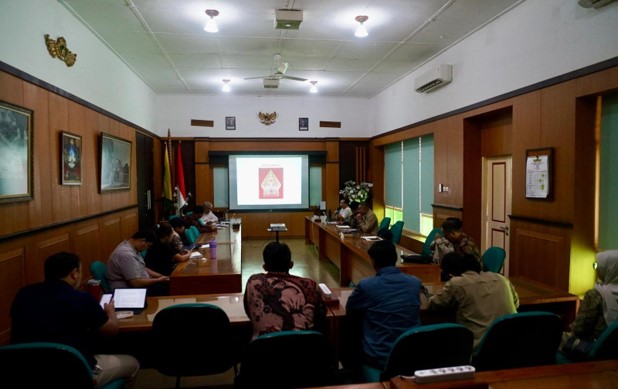
Learning about leadership is acquired with classroom theories and also direct experiences in environments rich in historical and cultural values. This spirit underpinned the Field Study for the Leadership and Cultural Transformation course, held at Puro Pakualaman, Yogyakarta, on Thursday (June 11th).
The activity was attended by 12 students from the Leadership and Policy Innovation Master Program (MKIK), Universitas Gadjah Mada, accompanied by course lecturers and academic mentors. This field study made students gain a deeper understanding of the relationship of leadership, culture, history, and social transformation within the context of the Special Region of Yogyakarta.
The event began with remarks from Pande Made Kutanegara, who emphasized the importance of contextual learning in cultural settings. According to him, Yogyakarta offers valuable lessons on culture, leadership, and democratic practices within its unique regional framework.
The main session was delivered by Sudibyo Prawiroatmodjo, who discussed leadership from the perspective of Javanese culture. He explained that effective leadership depends not on managerial and administrative capabilities and also on an understanding of cultural values, exemplary conduct, integrity, and the ability to maintain social harmony.
Students also explored the concept of power as depicted in the Babad Tanah Jawi, which illustrated the close relationship of culture, legitimacy, and leadership. They also learned about Asthabrata, a leadership philosophy derived from the Kakawin Ramayana, which highlights essential leadership qualities such as wisdom, courage, role modeling, responsibility, and commitment to public welfare.
The discussion further addressed cultural transformation and contemporary leadership challenges. Dr. Sudibyo emphasized that cultural transformation does not mean abandoning traditions; rather, it involves adapting relevant values to meet the demands of changing times. Puro Pakualaman serves as an example of a cultural institution that preserves its historical identity while adapting to social and technological developments.
Students, during the discussion session, raised issues related to digitalization, culture, democracy, and governance. At the conclusion of the program, Dr. Sudibyo highlighted four important values of Javanese leadership: ngadeg (steadfastness in truth), sabar (patience), bener (honesty and integrity), and kuwat (resilience in facing challenges). These values were considered highly relevant in addressing the complexities of the post-truth era.
This field study made students gain valuable experiential learning to enrich their understanding of leadership and cultural transformation in practice. The activity contributes to the achievement of the Sustainable Development Goals (SDGs), particularly SDG 4 (Quality Education) with contextual learning experiences, SDG 11 (Sustainable Cities and Communities) with the utilization of cultural heritage as a learning resource, and SDG 16 (Peace, Justice and Strong Institutions) with the strengthening of leadership values grounded in integrity, responsibility, and good governance.
Author: Yeti Susilowati