
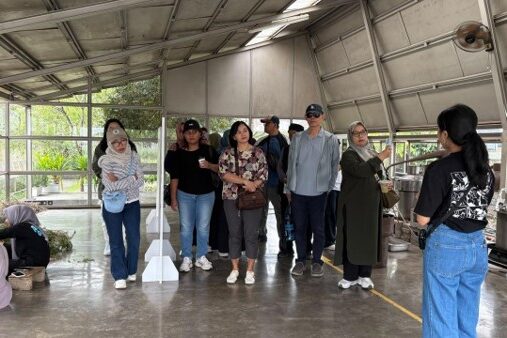
Yogyakarta, August 15th 2026 — The Media and Cultural Doctoral Program Graduate School, Universitas Gadjah Mada, held a Field Course on Cultural Production, Prosumption, and Representation of Heritage- and Nature-Based Tourism Spaces in Tawangmangu, Karanganyar Regency, Central Java, on Saturday (August 15th). The activity created part of an experiential learning approach designed to connect theoretical understanding with empirical observation of socio-cultural practices in the field.
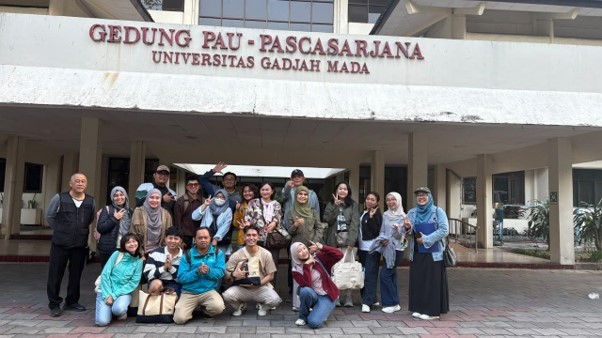
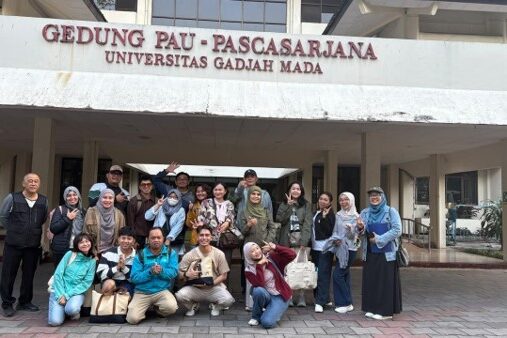
The field course was attended by program management, staff, faculty members, and students of the 2025 cohort. A total of 23 participants visited three locations: Rumah Atsiri Indonesia, Grojogan Sewu Waterfall, and Tawangmangu Tourism Market. The three sites were selected for their distinct representations of cultural heritage, local commodities, and nature-based tourism as spaces of cultural production.
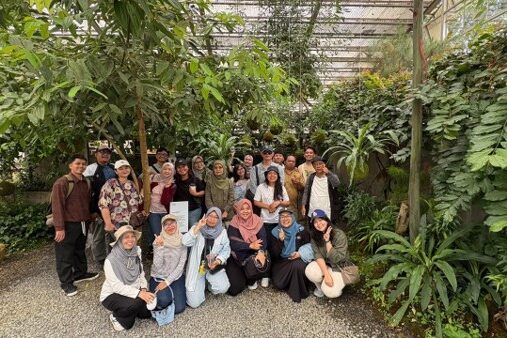
The first visit was to Rumah Atsiri Indonesia, where participants observed the production of aromatic plant commodities, the management of a cultural heritage-based creative industry, and the development of educational tourism. The direct observation made students explore how local commodities are developed and positioned in the context of the cultural economy and creative industries.
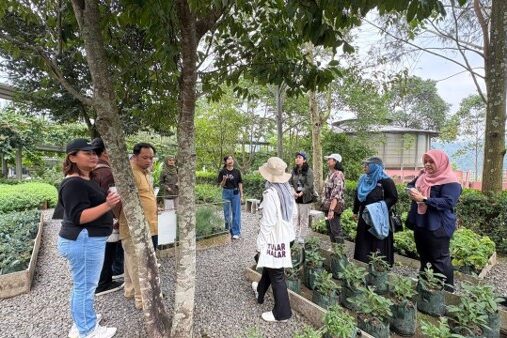
The group then continued to Grojogan Sewu Waterfall to observe practices of prosumption in nature-based tourism. Interactions among tourism managers, visitors, space, and tourist experiences became part of the observation. Tourism spaces were examined not merely as destinations, but also as arenas where cultural practices and experiences are produced.
The final visit took place at Tawangmangu Tourism Market, where participants explored cultural economic practices, the commodification of local products, and the representation of regional identity within tourism spaces. These activities provide insights of local products and regional identities and acquire meaning on tourism consumption practices.
The series of observations allowed students to connect the concepts of cultural production, prosumption, and representation with phenomena encountered directly in the field. The empirical experience made students be encouraged to examine how local commodities are produced and represented, how tourism experiences are constructed as cultural and economic value, and how tourism spaces become arenas for the formation of identities and cultural practices.
The field course also aimed to strengthen students’ theoretical and methodological perspectives in developing their dissertation research. Field observations are expected to contribute to academic discussions, enrich the development of relevant studies, and broaden students’ perspectives in understanding cultural and media phenomena in public spaces.
The activity, beyond its academic dimension, provided an opportunity to strengthen networks between the university and tourism destination managers as well as creative industry stakeholders. Engagement with various tourism spaces and practices in Tawangmangu provided empirical experiences that may support the development of future research and field studies.
This field course showed, learning extended beyond conceptual understanding in the classroom. Direct observation of production, consumption, prosumption, and representation in tourism spaces became part of the effort to broaden students’ perspectives in examining the dynamics of culture and media in contemporary society.
Author: Khoirul Mujazanah