
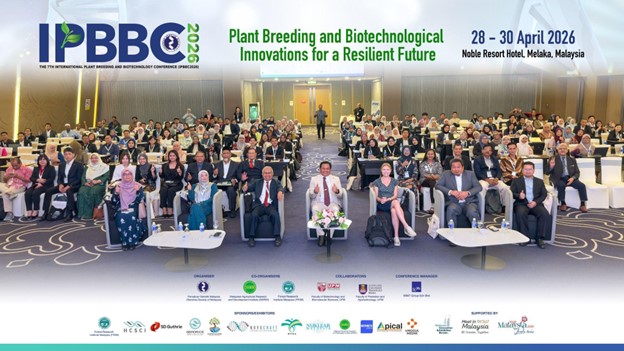
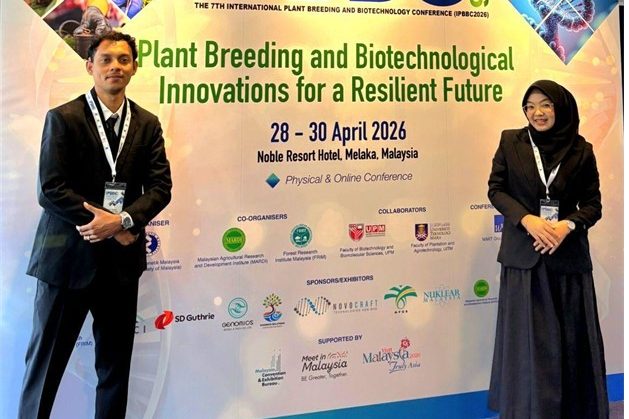
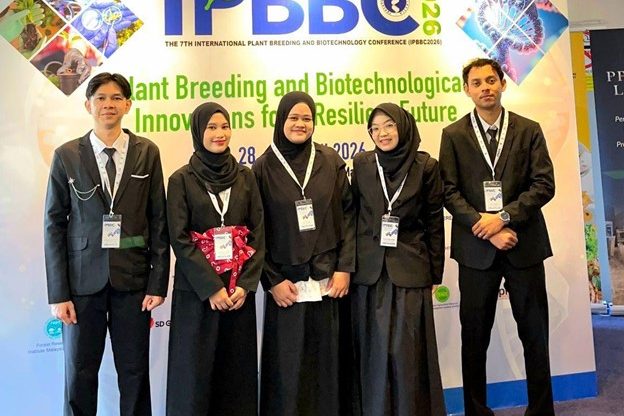
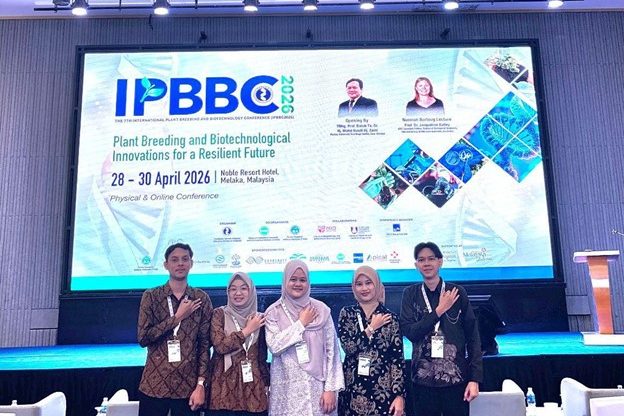
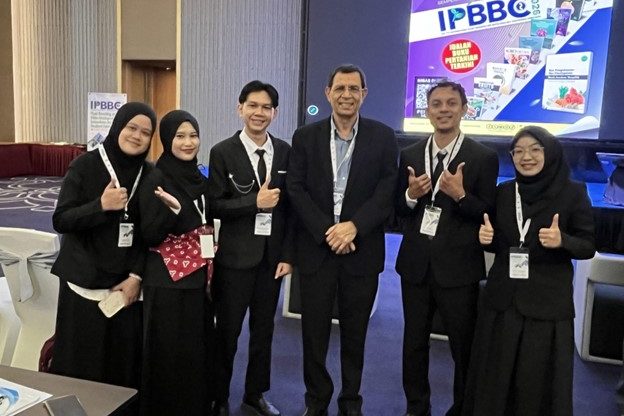
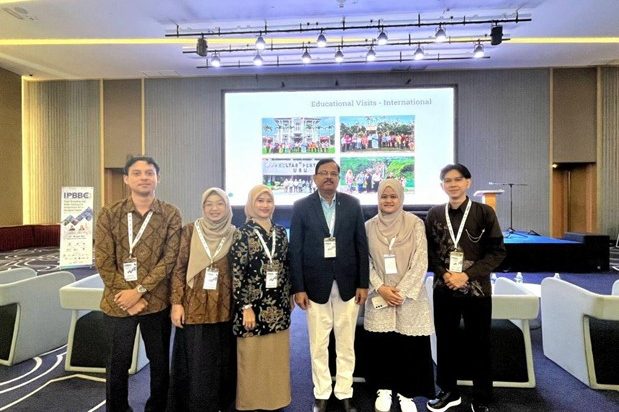
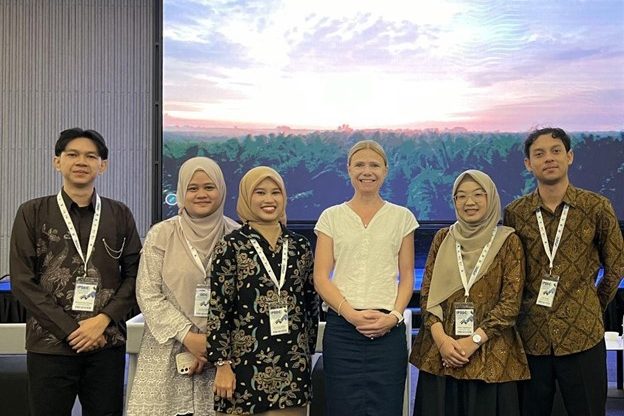
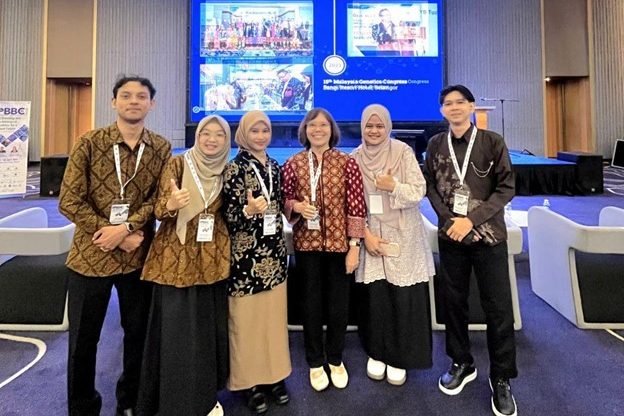
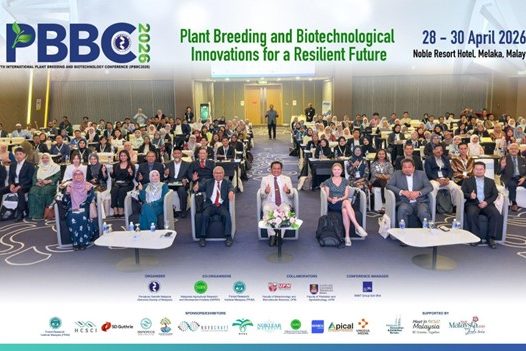
Malaysia, April 28th–30th 2026 – Students of Universitas Gadjah Mada (UGM) have achieved an outstanding accomplishment on the international forum. Five UGM students participated in The 7th International Plant Breeding and Biotechnology Conference (IPBBC 2026) held at Noble Resort Hotel, Melaka, Malaysia on April 28th–30th 2026. In this international scientific forum, all UGM delegations were selected as oral presenters and presented their research findings before academics, researchers, and practitioners from 10 countries.
The UGM delegation consisted of two students from the Biotechnology Master Program, UGM Graduate School, namely Jefri Saputro and Aviesta Linggabuwana, as well as three students from the Biology Master Program Faculty of Biology UGM, namely Muhammad Riyan Firnanda, Sri Garcinia Lathifah, and Zahrotin Saleha.
The active participation of UGM students in this international conference reflected UGM’s commitment as a world-class, innovative national university while also supporting the mission of the UGM Graduate School in conducting internationally competitive postgraduate research.
This participation was supported by the guidance and mentorship of their supervisors, Prof. Dr. Endang Semiarti, M.S., M.Sc., Prof. Dr. Yekti Asih Purwestri, S.Si., M.Si., and Wahyu Aristyaning Putri, Ph.D., as well as funding support from the Indonesia Endowment Fund for Education (LPDP). These supports play an important role in encouraging students to actively contribute to international scientific forums while introducing UGM’s leading research to the global community.
IPBBC 2026 was collaboratively organized by the Genetics Society of Malaysia together with the Malaysian Agricultural Research and Development Institute (MARDI), Forest Research Institute Malaysia (FRIM), Faculty of Biotechnology and Biomolecular Sciences Universiti Putra Malaysia (UPM), and the Faculty of Plantation and Agrotechnology Universiti Teknologi MARA (UiTM). Carrying the theme “Plant Breeding and Biotechnological Innovation for a Resilient Future,” the conference brought together participants from 10 countries, namely South Africa, India, Nigeria, the Philippines, Pakistan, Hungary, Bangladesh, Ghana, Indonesia, and Ethiopia.
This international conference served as a strategic platform uniting the global community of plant breeders, geneticists, biotechnologists, researchers, industry representatives, and students to explore the latest innovations in plant breeding and biotechnology. Various topics discussed focused on strengthening food security, enhancing plant resilience to climate change, and promoting sustainable agriculture for the future.
During the conference, Aviesta Linggabuwana presented a study entitled “Optimizing Genomic DNA Isolation from Vanda tricolor var. suavis Orchid to Support PCR-Based Biotechnological Applications in Plant Breeding.” Meanwhile, Jefri Saputro presented research entitled “Comparison of DNA Extraction Methods from Different Organs of Arachnis flos-aeris Orchid for PCR Based Analysis.” These studies represent preliminary research for thesis projects related to genome editing using CRISPR/Cas9 technology, which plays a crucial role in advanced molecular analyses such as PCR, sequencing, confirmation of plant genetic transformation, and precise single guide RNA design.
The students, in addition to serving as oral presenters, also attended plenary sessions featuring international experts from various countries, including Prof. Dr. Jacqueline Batley (The University of Western Australia), Prof. Dr. Prakash Kumar (National University of Singapore), Dr. Narayanan Chaendaekattu (Rubber Research Institute of India), Dr. Inez H. Slamet-Loedin (University Los Banos, Philippines), Dr. Farah Fazwa binti Md Ariff (Forest Research Institute Malaysia), Dr. Zulkifli Ahmad Seman (MARDI), and Prof. Dr. Taku Demura (NARA Institute of Science and Technology, Japan).
The speakers, during these sessions, discussed various strategic and emerging issues, ranging from genetic resilience in Brassica plants, plant adaptation mechanisms to salinity stress, rubber plant breeding strategies amid climate change, to genetic transformation innovations in rice for future global food security. The materials presented not only broadened participants’ academic perspectives but also opened opportunities for research collaboration and the development of sustainable agricultural innovations.
The conference activities also included networking sessions, allowing participants to exchange research experiences, expand international academic networks, and gain constructive insights for future research development. In addition, participants joined a field trip to the Faculty of Plantation and Agrotechnology UiTM to directly observe agricultural practices and harvesting processes of commodities such as mangoes and coffee.
The participation of UGM students in IPBBC 2026 is expected to enhance academic insight, strengthen research quality and innovation, and encourage more students to actively contribute to international scientific forums. It is in order to improve Indonesia’s global competitiveness, particularly in the fields of plant breeding and biotechnology.
Author: Aviesta Linggabuwana
Editor: Arfikah Istari