
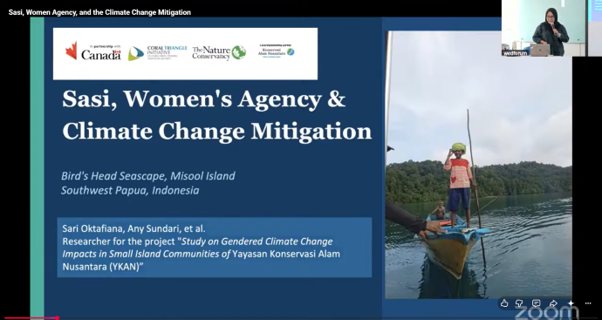
The Center for Religious and Cross-cultural Studies (CRCS), Graduate School of Universitas Gadjah Mada (UGM), held another session of its Wednesday Forum on Wednesday (May 13th) at the UGM Graduate School Building Unit 1. The forum featured Sari Oktafiana, an independent researcher and consultant whose work focuses on Gender Equality, Disability, and Social Inclusion (GEDSI), education, climate change, and renewable energy.
In her presentation, titled “Sasi, Women’s Agency and Climate Change Mitigation in the Bird’s Head Seascape (Misool Island), Southwest Papua,” Sari shared findings from her research on sasi, a customary marine resource governance system practiced in Misool Island, Southwest Papua. The study highlights the role of women in sasi management and their contributions to climate change mitigation efforts and the resilience of coastal communities.
The qualitative research conducted in the villages of Aduwei and Kapatcol showed that women’s groups such as Waifuna and Joom Jak play an active role in customary marine resource management. In addition to regulating access to marine territories, these groups help strengthen community capacity to cope with the impacts of climate change.
Women in Misool, according to Sari, have been able to assume strategic roles despite operating within customary social structures that remain largely male-dominated. “Women in Misool are not merely recipients of the impacts of climate change; they are also key actors who actively contribute to maintaining the sustainability of marine resources and strengthening community resilience through sasi practices,” she explained.
She further noted that women’s involvement in sasi governance demonstrates how local knowledge and collective community action can become important components of climate change mitigation and adaptation strategies. The findings also show that customary practices function not only as mechanisms for environmental conservation but also as spaces where women can expand their participation and leadership roles within their communities.
The discussion was highly interactive, engaging students, faculty members, researchers, and members of the public. Participants raised a range of questions concerning the relationship of local wisdom, natural resource governance, and climate change challenges in coastal areas.
The Wednesday Forum, CRCS UGM continues to provide an academic platform for dialogue on social, cultural, environmental, and religious issues that are relevant to contemporary societal challenges.
Author: Asti Rahmaningrum