
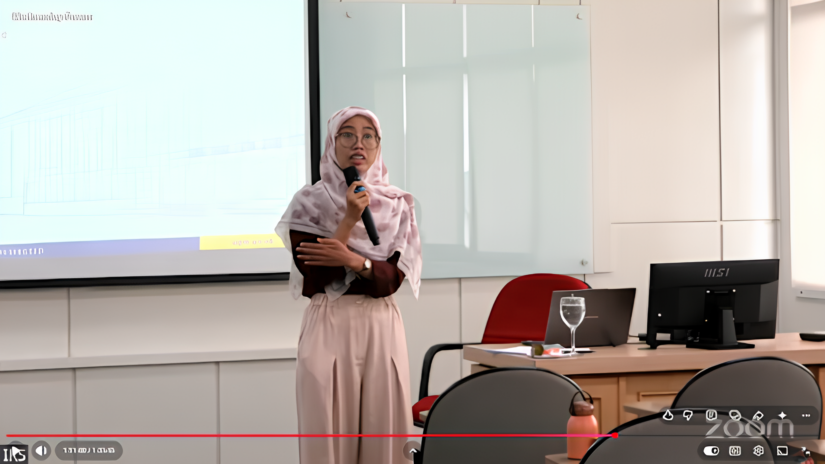
The Religion and Cross-Cultural Master Program, or the Center for Religious and Cross-Cultural Studies (CRCS), and the Inter-Religious Studies Doctoral Program, Graduate School of Universitas Gadjah Mada (SPs UGM), once again held the Wednesday Forum on Wednesday (24/08) at Unit 1 Building, Graduate School of Universitas Gadjah Mada. This regular discussion forum provides a space for exchanging ideas on various religious, social, and cultural issues.
The forum featured the theme “Islamic Constitutionalism in a Multiconfessional State: The Indonesian Constitutional Court and the Marriage Law”, with Laras Susanti, a lecturer at the Faculty of Law, UGM, as the speaker. The discussion explored how Islamic law interacts with Indonesia’s legal system as a democratic and multiconfessional state, with marriage law serving as an important arena for examining this dynamic.
Laras explained that the Indonesian Constitution does not specifically provide clear guidance on the relationship of religion and the state in her presentation. This condition has allowed the relationship of the two to be continuously interpreted and reinterpreted by policymakers and judicial institutions.
“The Indonesian Constitution does not specifically provide clear guidance on the relationship of religion and the state. The drafters and reformers of the Constitution left it to policymakers and the judiciary to interpret and reinterpret the relationship of the state and religion,” said Laras.
Laras then discussed the development of family law in Indonesia, including issues around interfaith marriage, the minimum age of marriage, the roles of husbands and wives, and polygamy. According to her, family law is an important arena due to its questions of religion, individual rights, state interests, and social change.
She also examined several cases concerning the Marriage Law brought before the Indonesian Constitutional Court. These cases demonstrate how freedom of religion and various interpretations of religious law intersect with constitutional principles in the judicial review of legislation.
Laras emphasized that Islamic law can be understood with various interpretations, including within the context of Indonesian society.
“I think we can support different things with different types of interpretations. When judges read and consider beliefs, we may see different interpretations.”
Laras Susanti is a graduate of the Faculty of Law, UGM, and holds a Doctor of Juridical Science (S.J.D.) from the University of Pittsburgh School of Law, where she was a Fulbright Award recipient. In addition to teaching, she is actively involved in research and legislative advocacy, with a particular interest in the social and political dynamics underlying legislative processes and judicial decision-making.
Writer: Asti Rahmaningrum