
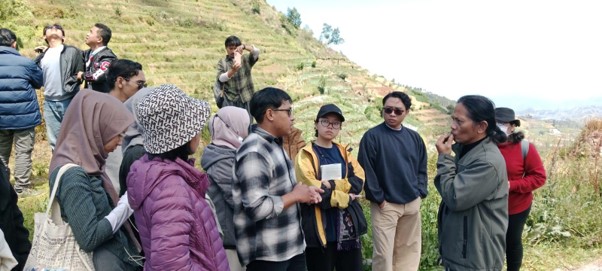
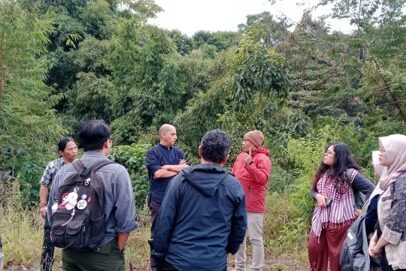
The Religion and Cross-Cultural Master’s Program Graduate School of Universitas Gadjah Mada (UGM), organized a field trip to Wonosobo and Dieng on July 23rd–24th 2026. The activity was attended by 16 second-semester students from the 2024 cohort and accompanied by Dr. Zainal Abidin Bagir, Dr. Samsul Maarif, Dr. Mark Woodward, and Dr. Najiyah Martiam.
The field trip was designed to enrich learning in three courses: Religion and Social Movement, Religion and Ecology, and Environmental Ethics. The activity enabled students to connect concepts and theories learned in the classroom with social, religious, agricultural, and environmental issues encountered by local communities firsthand.
The series of activities began on Thursday, July 23rd 2026, with a visit to Universitas Sains Al-Qur’an. The students then continued to Kampung Ilmu for a discussion with Farid Gaban on agriculture and community movements. On this occasion, the students also attended a seminar entitled “Environmental Problems in Indonesia and Wonosobo: How Can Religious Institutions Play a Role?” They also visited a greenhouse and discussed agricultural practices that combine local knowledge with modern technology.
On Friday, July 24th 2026, the activity continued with a visit to the geothermal area in Bedakah, followed by a discussion with members of the local community at Perpustakaan Rakjat. The discussion focused on community movements and the impacts of geothermal development on local residents and the environment.
For the students, direct engagement with local communities was one of the most memorable aspects of the field trip. Elly Muizatilah said that the visit and discussions on Agriculture 4.0, as well as the meeting with communities affected by geothermal development, allowed her to gain a more concrete understanding of issues that she had previously explored through readings and classroom discussions.
“Beyond the theory—perhaps that is one phrase that best describes this field trip,” Elly said.
The activity, according to her, provided students with an opportunity to understand how materials learned in the classroom are implemented in real life while also experiencing the perspectives and lived realities of local communities firsthand.
A similar impression was shared by Natasya Nikita Napitupulu. The visit to the geothermal area and the meeting with affected residents enabled her to directly observe realities that she had previously understood only through discussions and readings. Interactions with local residents and activists strengthened her understanding of environmental impacts and the efforts of communities to protect their living spaces.
Meanwhile, Marsekal Gembon highlighted two important experiences during the field trip: the meeting with Farid Gaban on farmers’ efforts to develop environmentally friendly agriculture and the discussion with the community in Dieng on efforts to protect living spaces, springs, and land for future generations.
According to Marsekal, the field trip was not merely an academic excursion but rather a “living learning space.” Students were able to witness how grassroots movements emerge from collective awareness and concern for the future. He also noted that local food issues are not only related to food security but are closely connected to cultural and economic resilience as well as environmental sustainability.
Writer: Asti Rahmaningrum