
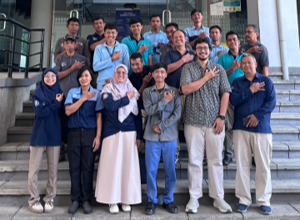
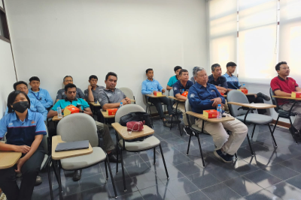
The utilization of Internet of Things (IoT) technology is one of the innovations supporting more measurable and data-driven waste management at Universitas Gadjah Mada (UGM). The IoT Waste Scale shows the weight of generated waste can be measured in real time at collection points (pick-up points), after the measurement data is transmitted and integrated into a digital system. The data can be used to support waste monitoring, evaluation, and management planning across the UGM environment.
The IoT Waste Scale is equipped with a strain-gauge load cell with a capacity of 150 kg and a resolution of approximately 0.1 kg. The system is supported by an Arduino Nano microcomputer and a Raspberry Pi 3B+, Wi-Fi and/or LAN connectivity, and a 7-inch LCD screen. The weighing results are then connected to an IoT server and can be monitored with a web-based dashboard providing information on waste weight and generation history.
Waste, in its implementation at UGM, is classified according to type: organic waste or food waste, recyclable or inorganic waste, residual waste, and result of sweepings consisting of leaves from both indoor and outdoor areas. This classification allows waste generation data to be recorded in a more structured manner according to its composition.
The weighing process begins by selecting the location where the waste originated with the Settings menu, followed by selecting the waste category, namely outgoing waste or incoming waste. Users then select the appropriate waste classification, prepare a container, and place the waste on the scale. Before weighing, users must ensure that the internet connection is active.
Users can press the “Weigh” button if the weighing is conducted without a container. When a container, such as a bucket, is used, the “Tare” button is pressed so that the weight of the container is excluded from the measurement. Once weighing is complete, the “Finish” button is used to send the measurement data to the server.
The integration of the weighing device and the digital system enables waste generation at UGM to be recorded in a more structured manner. The collected data indicates the weight of the waste and can also be used to monitor changes in waste generation and composition over time.
The weighing data can subsequently be monitored with the IoT Waste Scale Dashboard. The dashboard provides information on the composition of outgoing and incoming waste at each faculty, outgoing and incoming waste generation, daily waste composition and monthly trends, as well as waste generation at each faculty on a per-capita-per-day basis.
The availability of digital and real-time data supports more data-driven waste management at UGM. Information on the weight and composition of waste generated can serve as a basis for monitoring and evaluation and supporting waste management planning based on measurable conditions.
The integration of weighing devices, internet networks, servers, and dashboards, the IoT Waste Scale represents one application of digital technology supporting UGM’s efforts to establish a more measurable and well-documented waste management system. The systematic utilization of waste generation data is expected to strengthen evaluation processes and decision-making in waste management across the UGM environment.
The IoT Waste Scale Dashboard can be accessed through SIPS IoT UGM: SIPS IoT UGM.
This activity aligns with the implementation of the Sustainable Development Goals (SDGs), particularly SDG 3: Good Health and Well-Being; SDG 4: Quality Education; SDG 9: Industry, Innovation and Infrastructure; SDG 11: Sustainable Cities and Communities; and SDG 17: Partnerships for the Goals.
Writer: Ninda Syifa
Editors: Arni W.