
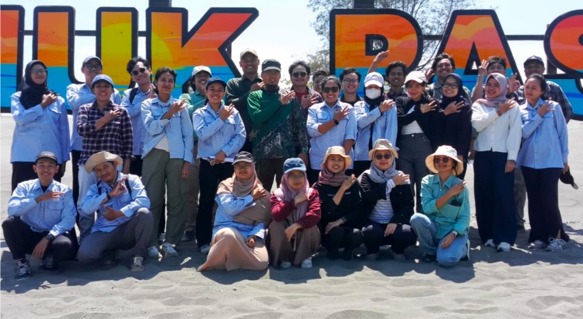
Yogyakarta, August 13th 2026 — New students of the Master’s Program in Environmental Management, Graduate School of Universitas Gadjah Mada, participated in a field orientation activity as part of the program’s academic orientation series. Focusing on landscape and environmental themes, the activity invited students to explore several areas across Yogyakarta, ranging from urban areas and the Bantul Graben to the Parangtritis sand dunes.
The activity was designed to introduce students to environmental conditions firsthand and to connect geomorphological processes with land use as well as the social and economic activities of local communities.
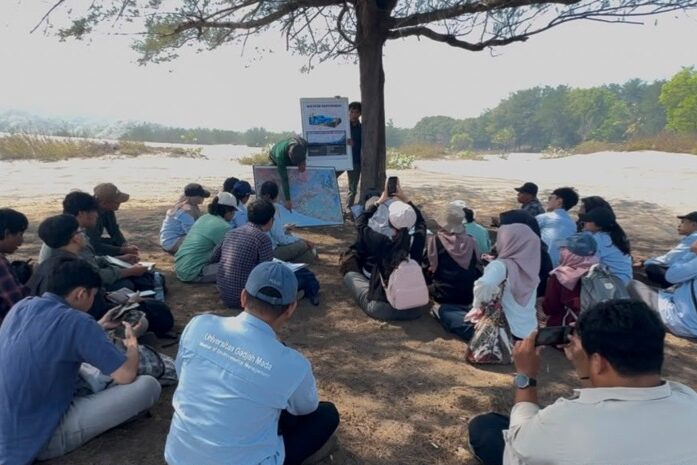
During the field trip, students received an explanation from Dr. Langgeng Wahyu Santosa about the diversity of landforms along the Merapi–Bantul Graben–Parangtritis route. Students observed various landforms, including volcanic, fluvial, structural, aeolian, and karst landforms, as well as the Wonosari Basin. This diversity shows the interconnection of natural processes, namely volcanic activity, erosion, sedimentation, river processes, and coastal dynamics, in shaping the landscape of Yogyakarta.
One of the main learning sites is the Parangtritis sand dune area, where students observed the formation of aeolian landforms with the transportation and deposition of sand by wind. The area also shows that landscapes are part of environmental systems that continuously interact with changes in land use, tourism activities, development, vegetation, and the socioeconomic conditions of local communities.
More than simply an orientation activity, exploring Yogyakarta’s Landscape provided a learning space for students to connect theory with field realities and understand the interrelationships among natural processes, spatial dynamics, communities, and environmental issues. The experience strengthened their understanding on regional management and required an integrated approach that considered environmental characteristics and dynamics as a whole. Students are expected to develop the ability to understand the potential and vulnerability of a region as a foundation for formulating environmentally sound, adaptive, and sustainable management strategies.
Writer: Siti Muyasaroh