
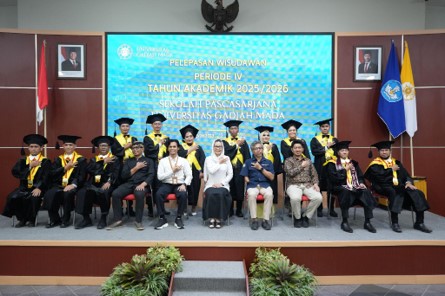
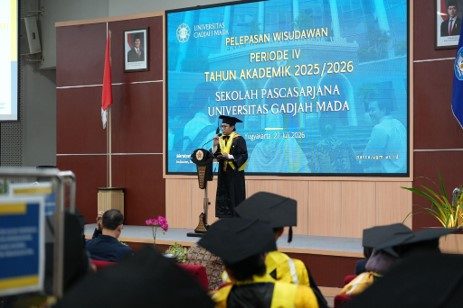
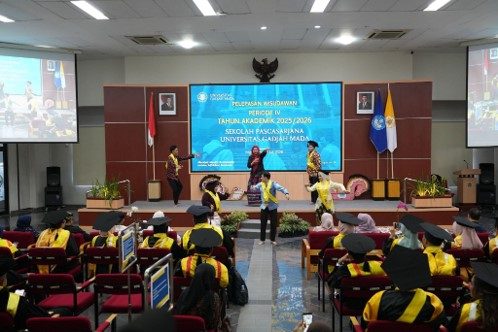
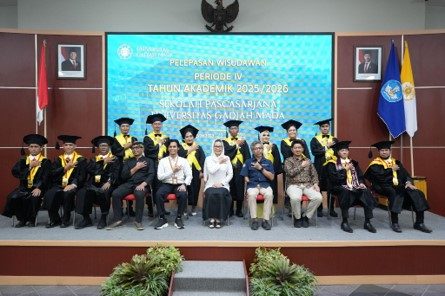
The Graduate School of Universitas Gadjah Mada (UGM) held a send-off ceremony for 89 masters (S2) and doctoral (S3) graduates at the 5th Floor Auditorium of the UGM Graduate School Building on Wednesday (July 22nd). The event served as a moment to reaffirm the graduates’ commitment to serving the nation by addressing complex national challenges through interdisciplinary approaches.
Representing the graduates, Angga Arfika from the Religion and Cross-Cultural Master’s Program expressed his gratitude to the lecturers who had guided and mentored them throughout their academic journey at the UGM Graduate School. “We would like to express our sincere appreciation to all our lecturers for nurturing and shaping us through both academic supervision and classroom learning during our studies at the Graduate School,” he said.
According to Angga, studying at the UGM Graduate School provided an environment where students learned that social, national, and environmental issues cannot be solved through a single academic discipline alone. “We are grateful to the Graduate School for fostering an interdisciplinary learning ecosystem. Here, we learned that national, social, and environmental challenges cannot be addressed by only one field of study,” he said.
He added that throughout their education, students were shaped by three core values: academic excellence, integrity, and social and environmental responsibility. These values, he said, serve as essential foundations for graduates to apply their knowledge for the benefit of society. “We have learned that earning a master’s or doctoral degree is not a source of personal pride, but a means of serving others and ensuring that the knowledge we possess benefits society. Graduation is not the end of the journey—it is the gateway to a broader path of service, as our nation awaits our dedication and contributions,” he said.
Prof. Ir. Siti Malkhamah, M.Sc., Ph.D., Dean of the UGM Graduate School, echoing Angga’s remarks, emphasized that one of the Graduate School’s greatest strengths lies in its multidisciplinary academic character. Currently, the Graduate School offers 14 master’s programs supported by faculty members from various disciplines, including engineering, humanities, agriculture, and philosophy.
She explained that this diversity of academic backgrounds strengthens collaboration in addressing increasingly complex challenges. On the occasion, Siti Malkhamah also underscored the importance of three forms of intelligence that every graduate should possess: spiritual intelligence, intellectual intelligence, and emotional and social intelligence. “Indeed, we need three kinds of intelligence: spiritual intelligence, intellectual intelligence, and emotional or social intelligence. With these, we are able to work together, develop empathy, and help one another. Bringing together people with different backgrounds and characters fosters empathy and strengthens the spirit of mutual cooperation,” she said.
She expressed hope that the knowledge and experience gained during their studies at the UGM Graduate School would enable graduates to make meaningful contributions to society. Siti Malkhamah also reminded graduates that both Indonesia and the global community are currently facing numerous challenges. However, she noted that these circumstances also present significant opportunities for graduates to contribute solutions through knowledge, collaboration, and social commitment. “We understand that both Indonesia and the world are facing difficult times. While this situation may give rise to concerns, it also creates opportunities for us to make meaningful contributions through knowledge and service,” she said. In closing, the Dean of the UGM Graduate School expressed her appreciation to the graduates’ families for their unwavering support throughout the students’ academic journey.
Writer: Arni W
Editor: Ana A