
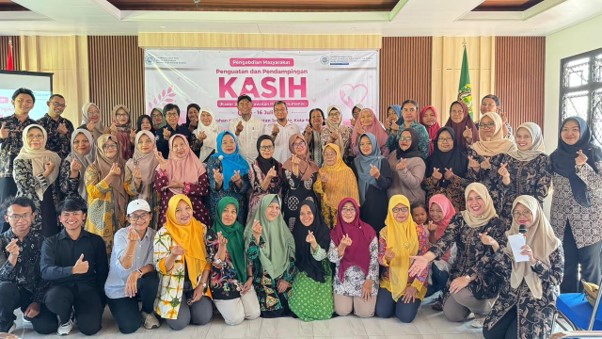
The Bioethics Master Program UGM Graduate School, organized a community engagement program entitled “Strengthening and Mentoring KASIH (Humanistic Palliative Care Cadres) in Kricak Village, Yogyakarta” on 15th – 16th July 2026 at the Kricak Village Hall, Tegalrejo District, Yogyakarta City. The opening session featured welcoming remarks from representatives of the Kricak Village Office, the Chief of Tegalrejo Community Health Center (Puskesmas), and the Head of the Master’s Program in Bioethics, UGM Graduate School, reflecting a shared commitment among academic institutions, healthcare providers, and local government to strengthen community-based palliative care. The initiative reflected the program commitment to empowering communities to provide compassionate and human-centered support for palliative care patients and their families.
The KASIH Program was designed to strengthen community-based palliative care by equipping community health volunteers and family caregivers with the knowledge and practical skills needed to support patients living with serious illnesses. This initiative made participants learn how to recognize patients’ changing conditions, provide safe and appropriate basic care, and identify situations requiring assistance from healthcare professionals.
The program featured four facilitators from Universitas Gadjah Mada: Prof. Dr. Apt. Sismindari S., Prof. Dr. Christantie Effendy, S.Kp., M.Kes., Dr. Sri Setiyarini, S.Kp., M.Kes., and Dr. Retna Siwi Padmawati, M.A. Together, they shared interdisciplinary perspectives on strengthening the capacity of community caregivers with the perspectives of bioethics, public health, and palliative care while emphasizing the importance of preserving patients’ dignity throughout the care process.
One of the keynote sessions was delivered by Prof. Dr. Christantie Effendy, who presented practical approaches to manage symptoms experienced by palliative care patients at home. She highlighted that palliative care is not solely about treating disease but also about relieving suffering, improving quality of life, and addressing patients’ physical, psychological, social, and spiritual needs. She further emphasized that palliative care should be introduced early and integrated alongside curative treatment whenever appropriate.
Participants were introduced to a practical five-step framework—Observe, Ask, Act, Record, and Contact—to help families monitor patients’ conditions, provide safe symptom management, document changes, and communicate effectively with healthcare providers. The training also covered the management of common symptoms experienced by palliative care patients, including pain, breathlessness, nausea and vomiting, fever, diarrhea, and constipation, as well as recognizing warning signs that require immediate medical attention.
The Master’s Program in Bioethics at UGM, with the KASIH Program, seeks to cultivate community caregivers who possess not only practical competencies but also ethical awareness and compassion in supporting patients and their families. By promoting collaborative, community-based palliative care, the program reinforces the importance of respecting human dignity throughout every stage of care.
This initiative also contributes to the achievement of the United Nations Sustainable Development Goals (SDGs), particularly SDG 3 (Good Health and Well-being) by promoting accessible community-based healthcare, SDG 4 (Quality Education) with capacity building for community health volunteers and family caregivers, and SDG 17 (Partnerships for the Goals) by fostering collaboration among the university, healthcare professionals, local government, and the wider community in advancing sustainable and inclusive palliative care services.
Writer : Yeti Susilowati