
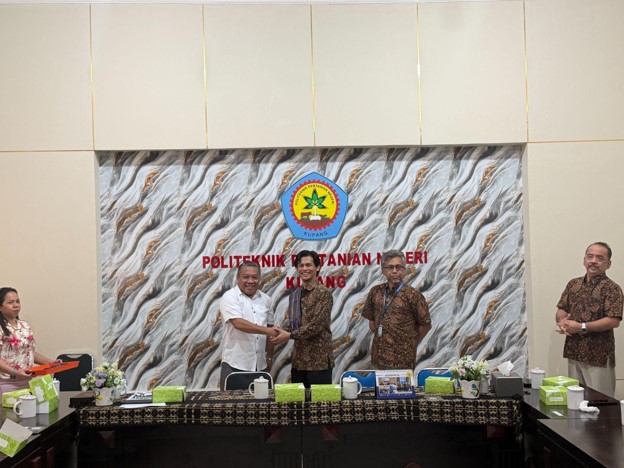
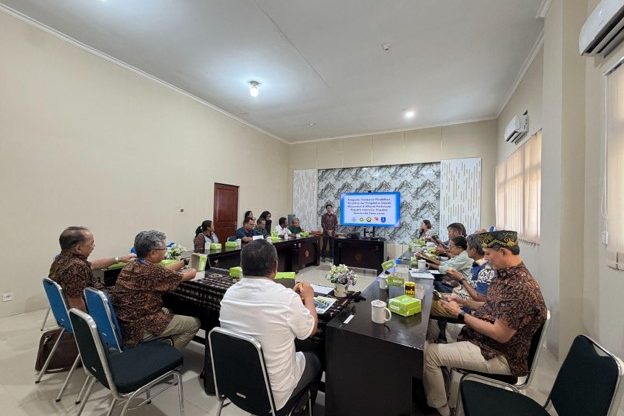
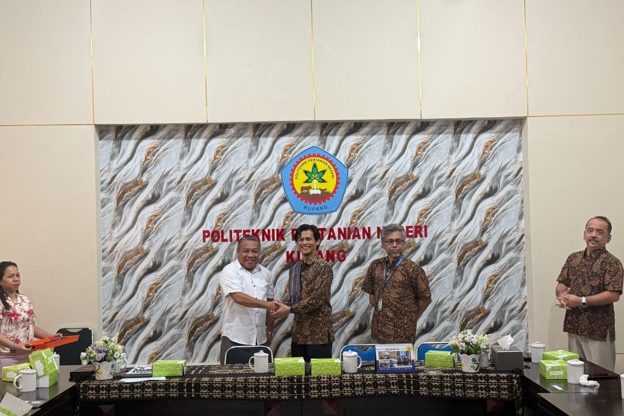
The Graduate School of Universitas Gadjah Mada (SPs UGM) paid a visit to the Kupang State Polytechnic of Agriculture as part of the Cross Border Partnership (CBP) program conducted in East Nusa Tenggara and Timor-Leste. The visit, held on Tuesday (July 14th) at the Rectorate Office of the Kupang State Polytechnic of Agriculture, aimed to explore opportunities for institutional collaboration while strengthening synergy in the implementation of the Tri Dharma of Higher Education, encompassing education, research, and community service.
The SPs UGM delegation was led by the Vice Dean for Academic Affairs, Student Affairs, and Cooperation, Prof. Dr. Ir. Widyanto Dwi Nugroho, S.Hut., M.Agr.Sc., and was welcomed by the First Vice Director for Academic Affairs of the Kupang State Polytechnic of Agriculture, Max A.J. Supit, S.Pt., GDI.pSc., M.FoodTech, along with his colleagues.
Ahmad Suparmin, S.P., M.Agr.Sc., Ph.D., Coordinator for Research and Publication Quality Assurance at SPs UGM, during the meeting, presented a number of research and community service initiatives currently being undertaken by SPs UGM faculty members in East Nusa Tenggara. One of the highlighted projects focused on identifying watershed (DAS) locations across the province as part of efforts to promote sustainable water resource management. The research is expected to provide a scientific basis for regional development planning, environmental conservation, and the mitigation of water availability challenges in the region.
Prof. Widyanto Dwi Nugroho emphasized that the Cross Border Partnership serves as an important platform for expanding collaborative networks of SPs UGM and higher education institutions across Eastern Indonesia. He expressed his hope that this initial engagement would generate collaborative initiatives that not only strengthen the implementation of the Tri Dharma of Higher Education but also contribute meaningful development challenges in border regions.
The leadership of the Kupang State Polytechnic of Agriculture welcomed the initiative and expressed their commitment to maintaining active communication while exploring various forms of future collaboration. The meeting marked an important first step toward establishing a mutually beneficial partnership by leveraging the respective strengths and expertise of both institutions.
Author: Asti Rahmaningrum