
Yogyakarta, 4th February 2026 — Tuberculosis (TB) remains one of the major public health challenges in Indonesia. In response to this issue, a research team from the Biomedical Engineering Master’s Program, Graduate School of Universitas Gadjah Mada (UGM), in collaboration with the Department of Electrical Engineering and Information Technology (DTETI), Universitas Gadjah Mada, has developed an innovation entitled Automated Endemic Bacteria Detection System Based on Artificial Intelligence (AI) and the Internet of Things (IoT).
This innovation, which integrates mechanical automation and digital intelligence, was officially introduced to the public during the DTETI Open House held on 21th–22th November 2025 at the Gelanggang Inovasi dan Kreativitas (GIK) UGM.
The head of the research team, Ir. Ridwan Wicaksono, S.T., M.Eng., Ph.D., emphasized that accelerating and ensuring consistency in diagnosis is a key factor in breaking the chain of TB transmission. He stated conventional manual diagnostic processes still face challenges such as lengthy examination times and the potential for human error.
“We leverage technology to overcome the limitations of conventional diagnostics. Through a fully integrated system, from sample preparation to data analysis, we hope this innovation can support healthcare facilities in Indonesia in conducting large-scale TB detection more quickly, accurately, and consistently,” said Ridwan during the exhibition.
The developed system offers a comprehensive, end-to-end solution through a series of automated processes. The initial stage begins with the automated staining of sputum samples using the Ziehl–Neelsen (ZN) method. Supported by an ESP32 microcontroller, the system precisely controls reagent syringe pumps, water pumps, and heating modules, ensuring a consistent TB bacteria staining process without direct human intervention.
Furthermore, the innovation includes the development of an automated, motorized microscopy system. Conventional microscopes were modified to enable automatic focus searching using stepper motors, allowing bacterial images to be displayed with optimal sharpness without reliance on operator skill.
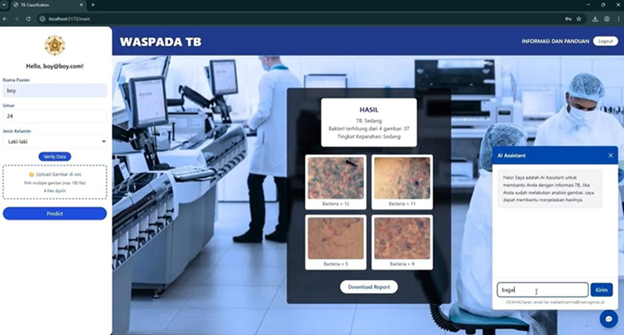
The resulting microscopic images are then uploaded to an IoT-based platform integrated with patient data. At this stage, artificial intelligence plays a critical role in automatically analyzing the images to calculate bacterial counts and determine the severity of infection. The system is equipped with an AI Assistant feature that provides explanations of the analysis results along with recommendations for further medical action, resembling an initial consultation with a healthcare expert.
The medical reliability of the system is strengthened through interdisciplinary collaboration with the Faculty of Medicine, Public Health, and Nursing (FKKMK) UGM. Testing was conducted using real sputum samples from TB patients under the supervision of Prof. Titik Nuryastuti, ensuring that the technology has been validated under real clinical conditions.
This innovation is the result of collaboration among lecturers and young researchers from various disciplines, including Ir. Ridwan Wicaksono, S.T., M.Eng., Ph.D.; Dr. Indah Soesanti, S.T., M.T.; Nadya Aji Salsabila, S.T., M.Sc.; Mahasti Namira, S.T.; Anisa Nur Rahmalina; and Gabriel Aryo Wicaksono, S.T. The presence of this system is expected to serve as a tangible contribution from UGM in supporting TB elimination efforts in Indonesia through the application of intelligent technologies.
Source: Ridwan Wicaksono
Editor: Asti Rahmaningrum
Photo: Ridwan Wicaksono