
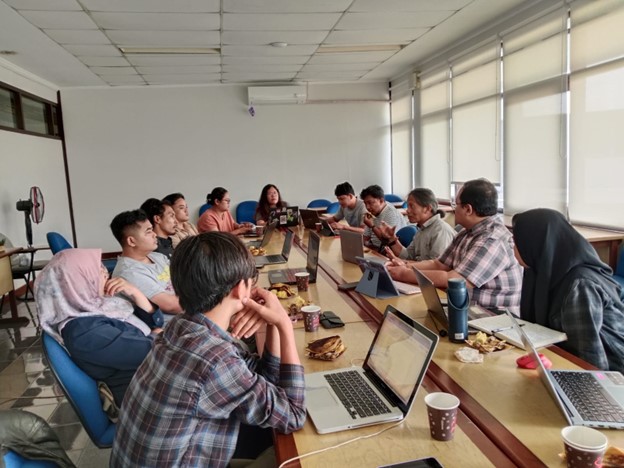
The Religion and Cross-Cultural Master Program Graduate School of Universitas Gadjah Mada (SPs UGM), held the Freedom of Religion or Belief (FoRB) Clinic Workshop on February 2nd 2026, at Unit 3 Building of the UGM Graduate School. The workshop was part of the process of drafting a book entitled “Intersectionality of Freedom of Religion or Belief.”
The workshop featured Dr. Samsul Maarif, M.A. as the keynote speaker, who delivered an introduction on the importance of an intersectionality approach in examining issues related to freedom of religion or belief in society. In his presentation, he emphasized that a social case cannot be understood from a single perspective but should be examined through the interconnection of various issues that influence one another.
“An intersectional approach helps us understand that a case rarely stands alone. It may involve issues of religion, children’s rights, women’s rights, as well as social dynamics that develop in society and the media,” explained Dr. Samsul Maarif.
The workshop specifically examined a case of grave vandalism committed by a teenager in Bantul Regency in May 2025. This activity showed participants jointly analyzed the case using an intersectional approach to better understand the various dimensions of the issues involved.
The event was attended by members of the FoRB Clinic of the Special Region of Yogyakarta (DIY), consisting of various civil society organizations (CSOs) and community groups working on issues related to religion, women, children, law, human rights, and interfaith dialogue. The diverse backgrounds of the participants enabled rich discussions and the exchange of multiple perspectives and experiences.
During the discussions, participants addressed the issue of religious intolerance and also highlighted other interconnected issues, such as the protection of children’s rights, women’s rights, and how the incident was represented in the media.
One of the staff from the Religion and Cross-Cultural Master’s Program, Ribka, shared her impression of the workshop. According to her, the activity was both engaging and important as it helped participants understand a case from multiple perspectives.
“The activity helped us see and understand the case from various perspectives. From the analysis of the grave vandalism case, for instance, we can identify several issues, ranging from violations of children’s rights and women’s rights to intolerance reflected in the media,” she said.
Ribka further added that the results of the case analysis conducted together with participants from various institutions and communities are expected to serve as a model for handling and advocating similar cases in the future. The workshop also served as a collaborative space to strengthen intersectional perspectives in efforts to protect freedom of religion or belief in society.
Author: Asti Rahmaningrum