
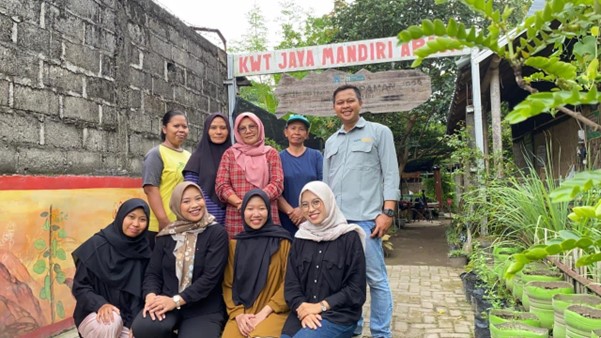
Yogyakarta, February 24th 2026 — A research team from the Graduate School of Universitas Gadjah Mada (UGM), led by Dr. Najmu Tsaqib Akhda, conducted a field visit to the Jaya Mandiri Abadi Women Farmers Group (Kelompok Wanita Tani/KWT) in Ngancar Hamlet, Tridadi, Sleman. The visit constituted an important part of a research project entitled “Development of an Integrated Agriculture Model Based on Local Wisdom as a Rural Community Empowerment Model (Case Study of Lumbung Mataraman in the Special Region of Yogyakarta).”
The research covers all regencies in the Special Region of Yogyakarta, with one representative group selected from each area as a sample. KWT Jaya Mandiri Abadi was appointed to represent Sleman due to its active implementation of the Lumbung Mataraman concept and its sustainable integrated farming system.
Siti Sugiyati, Chief of KWT Jaya Mandiri Abadi, explained that the Lumbung Mataraman activities initially began with planting household yard commodities such as chili, mustard greens, water spinach, and baby cucumbers. Today, the group also manages two tarpaulin ponds for catfish farming and raises approximately 320 chickens.
“This KWT was established on January 5th 2015, initiated by members of the Family Welfare Movement (PKK). It currently has 16 active members who manage various horticultural crops, catfish farming, and poultry production. A closed-loop agriculture system has been implemented, from utilizing organic waste as fertilizer to integrate fish ponds to enhance soil fertility,” said Siti Sugiyati.
According to Najmu, as a lecturer in the Development Extension and Communication Study Program at the UGM Graduate School, Lumbung Mataraman serves as both a center of activities and a symbol of local food security rooted in the philosophy: “Nandur Apa Sing Dipangan, Mangan Apa Sing Ditandur” (Plant what you eat, eat what you plant).
“The research findings indicate that the practices of KWT Jaya Mandiri Abadi strengthen social, economic, environmental, and cultural sustainability. They also provide strong evidence of women’s empowerment in community food management. Social capital such as trust, mutual cooperation, and community networks forming the essential foundation for the sustainability of the food barn,” Najmu added.
In addition to strengthening local food security, the activities of KWT Jaya Mandiri Abadi align with several Sustainable Development Goals (SDGs), particularly SDG 2 (Zero Hunger), SDG 5 (Gender Equality), and SDG 12 (Responsible Consumption and Production). Their integrated farming practices not only enhance the availability of healthy food within the community but also reinforce women’s roles in decision-making related to food production. The use of organic waste as fertilizer, the integration of fish ponds with gardens, and consumption patterns based on local production demonstrate tangible contributions to sustainable resource management.
Source: Najmu Tsaqib Akhda
Editor: Asti Rahmaningrum
Photo: Najmu Tsaqib Akhda