
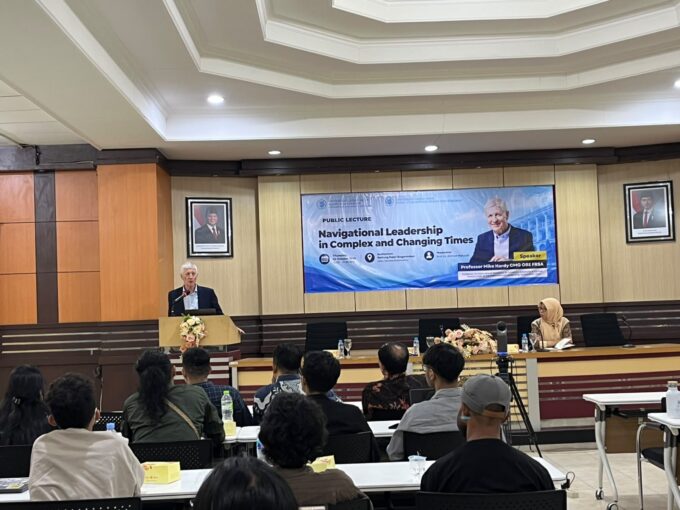
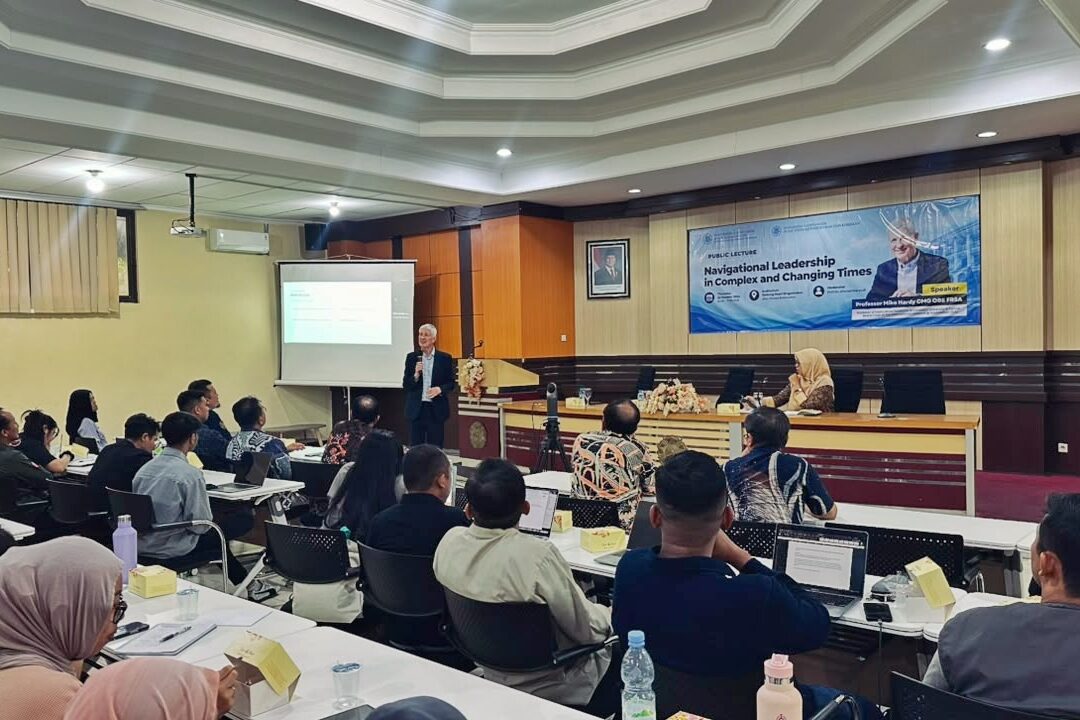
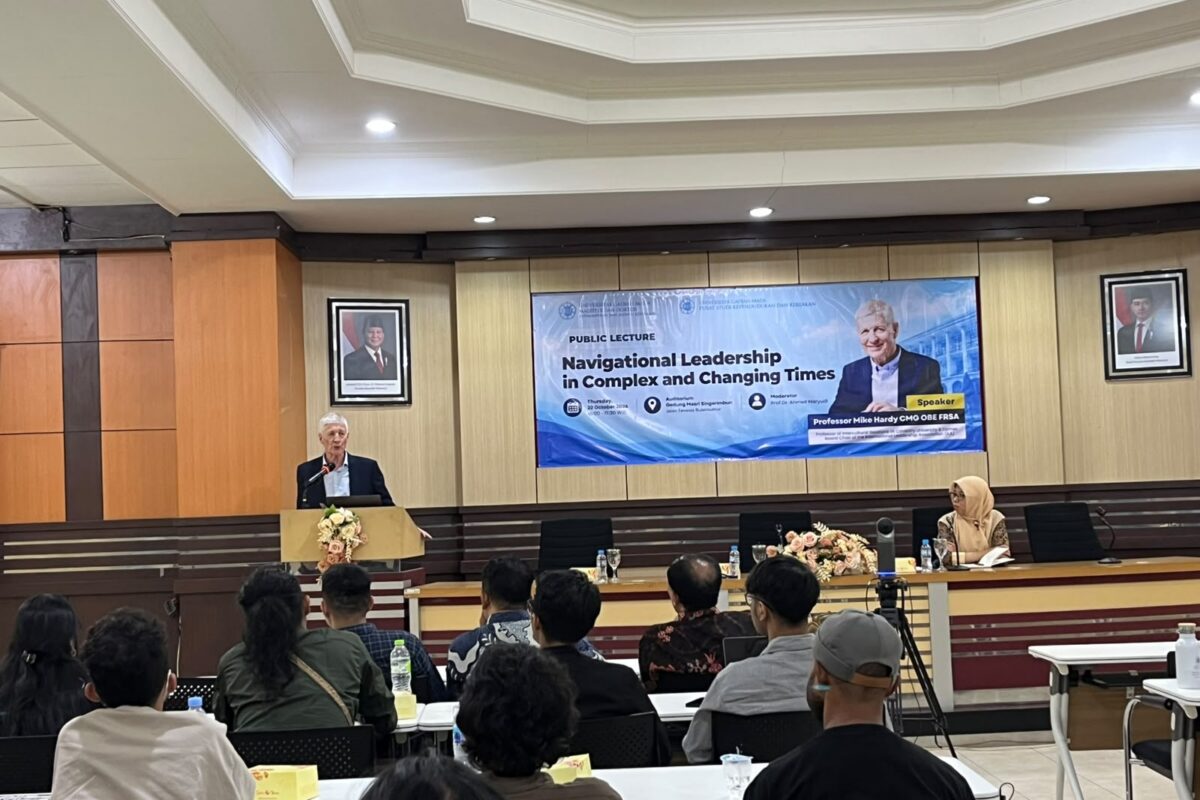
Yogyakarta, 22nd October 2026 — Increasingly complex global changes require leaders to develop the ability to interpret situations, understand the interconnectedness of various challenges, and determine the right direction amid uncertainty. These issues were the focus of a public lecture entitled “Navigational Leadership in Complex and Changing Times”, organized by the Leadership and Policy Innovation Master and Doctoral Program (MDKIK), Graduate School, Universitas Gadjah Mada (UGM), on Thursday (22nd October). The event featured Professor Mike Hardy, CMG, OBE, FRSA, Professor of Intercultural Relations at Coventry University, United Kingdom, as the speaker, with Prof. Dr. Ahmad Maryudi serving as the moderator. The public lecture was held at the Auditorium of the Masri Singarimbun Building, UGM.
Professor Mike Hardy, in his presentation, introduced the concept of Navigational Leadership as an approach to leadership in situations characterized by continuous change and unpredictability. He explained that leaders cannot always rely on existing maps, past experiences, or established strategies to determine their course of action. The ability to read developments in the surrounding environment, recognize ongoing changes, and adjust decisions accordingly. It becomes increasingly important when challenges are interconnected and have no single solution.
One of the key topics discussed was the distinction of crisis and rupture. A crisis refers to a disruption in which a system can still potentially be restored to its previous condition. A rupture, on the other hand, represents a more fundamental transformation in which the former conditions cannot be fully restored, requiring new perspectives and arrangements. This distinction has important implications for leadership responses. Not every challenge can be addressed simply by restoring the previous situation; some require policy changes and the development of systems better suited to emerging realities.
To illustrate the importance of this approach, Professor Hardy drew on several experiences in Indonesia, including land subsidence in Jakarta, the post-2004 tsunami reconstruction in Aceh, the 2006 Yogyakarta earthquake, and the 2010 Mount Merapi eruption. These events demonstrate that responding to change and disasters involves more than simply rebuilding damaged infrastructure. Leaders must also consider public safety, environmental resilience, changes in governance, and community involvement in determining the direction of recovery and future development.
Furthermore, Professor Hardy outlined several shifts in contemporary leadership practices. Leadership needs to move from simply following established paths towards navigating uncertainty; from relying on positional authority towards building trust; and from providing unilateral certainty towards facilitating collective decision-making. He also emphasized the importance of translating commitments into concrete actions rather than allowing them to remain mere promises. Accordingly, leadership should not focus solely on restoring normal conditions, but also on creating a better future.
Within this framework, he introduced four orientations of Navigational Leadership: Looking Out, Looking Together, Looking Through, and Looking In. These four orientations emphasize the importance of observing the external environment, developing shared understanding with various stakeholders, recognizing the interconnectedness of different challenges, and reflecting on oneself and one’s position as a leader. This approach highlights that decision-making cannot take place in isolation. Leaders need to create opportunities for dialogue, consider diverse perspectives, and understand the broader implications of their decisions.
The perspective of navigational leadership was also discussed in relation to public policy challenges, including the energy transition, climate change, social integration, and the prioritization of development agendas. During the discussion session, participants raised the issue of Indonesia’s dependence on fossil fuels amid growing efforts to develop renewable energy. This discussion highlighted how energy policy intersects with various dimensions, ranging from energy security and economic conditions to state revenue and environmental sustainability. Consequently, policies need to consider not only short-term consequences but also their long-term impacts on future generations.
The discussion also addressed leadership in multicultural societies, intergenerational collaboration, and the importance of building trust amid differences. In this context, local Indonesian values such as musyawarah (deliberation) and gotong royong (mutual cooperation) can serve as valuable foundations for developing collaborative leadership practices. Leadership is not determined solely by formal authority or seniority, but also by the ability to listen, welcome input, build relationships, and involve diverse groups in addressing shared challenges.
For postgraduate students, the concept of Navigational Leadership offers an opportunity to reflect on the importance of interdisciplinary thinking, adapting to change, and developing a long-term policy orientation. The public lecture also enriched academic perspectives on the relationship of leadership, policy innovation, and the complexity of public challenges. Through this event, the Graduate School of UGM encourages the development of leadership perspectives that are responsive to current challenges and also capable of anticipating change and shaping the future with collaborative and sustainable approaches.
Author: Khoirul Mujazanah