
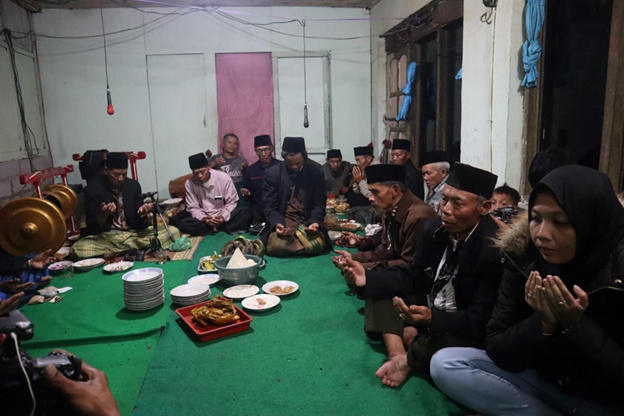
Yogyakarta, March 31st 2026 — The Performing Arts and Fine Arts Studies (PSPSR) Master Program, Graduate School of Universitas Gadjah Mada (UGM), has received the 2025 Graduate School Research Grant (SPs). This study is titled “Srandul Sunti: Embracing Vows, Preserving Tradition” and focuses on the sustainability of traditional folk art in the slopes of Mount Sumbing, Magelang.
The research is led by Dr. Rr. Paramitha Dyah Fitriasari, M.Hum., with team members Dr. G.R. Lono Simatupang, M.A., Dr. Tri Mastoyo, M.Hum., and Heni Siswantari, M.A. The research team explored the practice of Srandul Sunti as a form of folk art that is closely related to the values of vows (nazar), the sacredness of domestic spaces, and the spiritual relationship between patrons and performers.
Srandul Sunti performances are consistently held within domestic spaces using traditional lighting known as oncor. This practice creates an intimate and simple ritual atmosphere, which is rich in symbolic meaning. The ethnographic approaches and performativity analysis, the researchers found that this art form faces serious challenges, particularly in terms of cultural transmission.
All current Srandul Sunti performers are over 50 years old, with no involvement from younger generations. The lack of regeneration is driven by the perception that this art form belongs to the “elderly domain,” the view that the performance is complex and demanding, and the shifting interests of younger generations toward more popular art forms such as kuda lumping, topeng ireng, and gedrug.
This condition reflects weak sustainability factors, particularly in terms of cultural inheritance, learning motivation, and the ability to adapt to evolving social and cultural contexts. The findings highlight that although Srandul Sunti holds significant historical, religious, and social value for the community, it is currently at a critical point, facing the risk of extinction.
The presence of senior performers as “repositories of knowledge” remains the main pillar sustaining this artistic practice. However, without well-planned and strategic transmission efforts, the sustainability of Srandul Sunti is increasingly at risk. “Srandul Sunti is not merely a performance, but a space where tradition, belief, and community identity converge and must be collectively preserved,” said the lead researcher, Dr. Rr. Paramitha Dyah Fitriasari.
The results of this study are expected to provide academic contributions as well as practical recommendations for preserving ritual arts in rural areas of Java, while also strengthening awareness of the importance of sustaining local cultural heritage.
This 2025 SPs-funded research is also aligned with the Sustainable Development Goals (SDGs), particularly SDG 4 (Quality Education) through the strengthening of cultural education and the transmission of local knowledge, SDG 11 (Sustainable Cities and Communities) through the preservation of cultural identity and community-based artistic practices, and SDG 17 (Partnerships for the Goals) through collaboration among academics, local communities, and educational institutions in sustaining traditional arts.
Source: Paramitha D Fitriasari
Editor: Asti Rahmaningrum
Photo: Paramitha D Fitriasari