
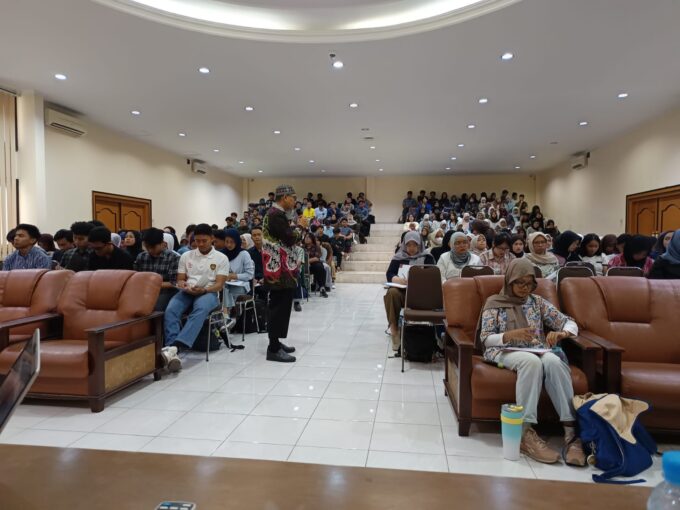
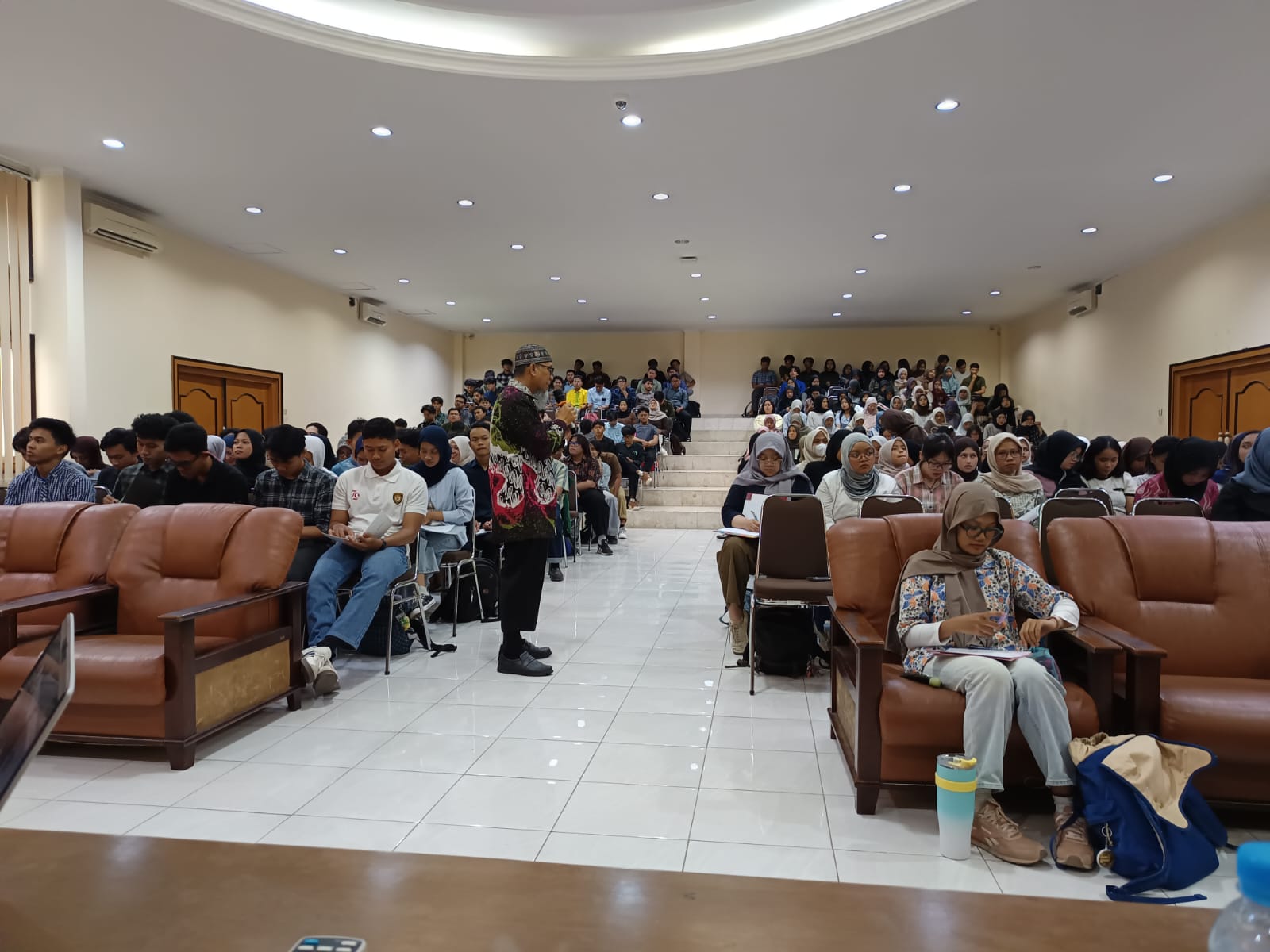
The Population Master and Doctoral Programs at the Graduate School of Universitas Gadjah Mada (SPs UGM) successfully organized a public lecture entitled “Demographic Resilience in Facing Demographic Change and Pressure” on Thursday, August 27th 2026, at the Merapi Auditorium, Faculty of Geography, UGM. The event was held as a forum for knowledge sharing on population dynamics and strategies for building resilience amid the demographic changes currently in Indonesia.
The event was attended by all 2026 undergraduate students of the Faculty of Geography and students of the Population Master Program who actively participated in discussions on demographic change, the importance of improving human resource quality, the availability of decent employment opportunities, and strengthening family resilience as a key foundation of demographic resilience. The discussion also highlighted the context of development in Papua, which has distinct demographic, geographical, social, and economic characteristics. This area requires population policy approaches that are not similar with those applied in other regions of Indonesia.
The lecture was delivered by Dr. Agus Joko Pitoyo, S.Si., M.A., Chief of the Population Studies Doctoral Study Program. He explained that demographic change is part of the development process and can present both opportunities and pressures. These changes include fertility, mortality, migration, age structure, population distribution, and family structure. Demographic changes create opportunities if the government and society have the capacity to anticipate it. The demographic dividend, for instance, can be a start up for development if the working-age population has adequate access to education, healthcare, skills development, and decent employment opportunities. A large working-age population may instead lead to higher unemployment and increased social burdens if the quality is low and employment opportunities are limited.
One of the key demographic pressures is declining fertility and population ageing. He explained that if fertility decline continues over the long term, a region may even face the risk of population collapse, a condition in which the number of young and working-age people continues to decrease while the proportion of older people grows. A shrinking working-age population and an increasing dependency burden, along with changes in family structure—such as the tendency to marry at older ages and have fewer children—can further contribute to demographic pressure.
Ultimately, demographic resilience provides a perspective that population development must be pursued in an adaptive and sustainable manner. Policies should not focus solely on increasing or controlling population size, but should also take into account population quality, age structure, family resilience, population mobility, employment opportunities, health, education, and social protection. Demographic resilience is built with the ability to anticipate change, adapt to pressures, and ensure that demographic changes can continue to be directed toward supporting societal well-being.
This public lecture showed students are expected to gain a more comprehensive understanding of population dynamics and strategies for building resilience amid the demographic changes currently facing Indonesia. Therefore, demographic change should not be viewed solely as a threat. It can also become an opportunity if the government and society have the capacity to anticipate and respond to it effectively.
Writer: Nabila Rizkia Nada
Editor: Siti Muyasaroh