
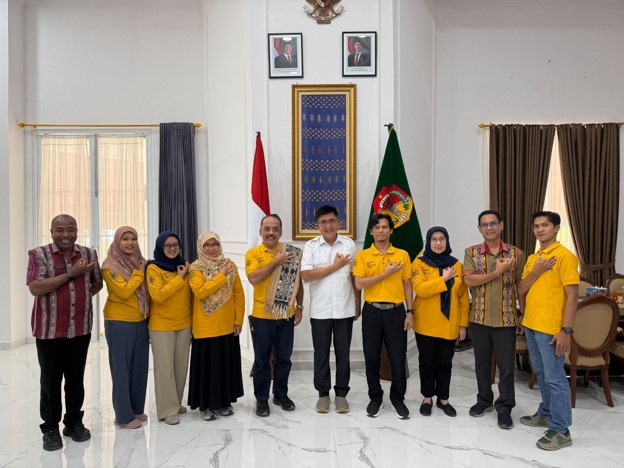
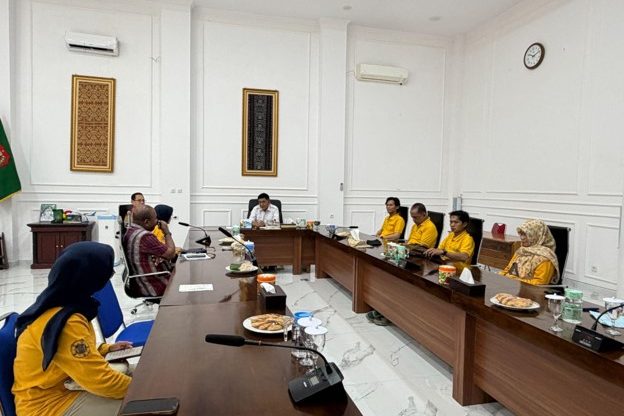
Poverty alleviation with research-based approach emerged as one of the key topics during an audience of the delegation from the Graduate School of Universitas Gadjah Mada (SPs UGM) and the Regent of Belu, Willybrodus Lay, S.H., at the Belu Regent’s Office on Thursday (July 16th). The meeting was part of the Cross Border Partnership (CBP) program organized by SPs UGM in East Nusa Tenggara Province and Timor-Leste.
Regent Willybrodus Lay, during the meeting, emphasized that the development challenges faced by Belu Regency extend beyond increasing agricultural production. More importantly, he stressed the need to ensure that agricultural productivity improves household welfare. According to him, the majority of Belu residents depend on agriculture for their livelihoods. However, most farmers cultivate relatively small plots of land, resulting in limited income that is often insufficient to adequately support their families.
He explained household income’s improvement is a fundamental step to enhance the quality of life of local communities. Better economic conditions would enable families to meet their nutritional needs, provide better education for their children, and fulfill other basic necessities.
“We hope that the research conducted by the UGM Graduate School will generate recommendations and innovations will help improve the economic well-being of families in Belu. As household incomes increase, families will be better able to meet their nutritional needs, invest in education, and fulfill other basic necessities,” said Willybrodus Lay.
The Regent also linked these issues to the research presented by Dr. Hilda Ismail, Apt., M.Si., which examined the relationship of health factors, environmental conditions, and stunting. In his view, stunting should be examined from a broader perspective by considering the socio-economic conditions of the community, including land ownership and agricultural land management, which remain the primary sources of livelihood for most households in Belu.
Willybrodus Lay, during the discussion, also shared findings from his own research on the causes of poverty in Belu Regency. One of the key findings identified crop failure as the most significant factor contributing to poverty in the region, as its direct effects on households’ ability to meet their daily needs.
Reflecting on the changing economic conditions over the past several decades, he remarked, “About thirty years ago, families could still afford to send their children to school simply by selling one cow. Today, that is no longer the case. The question we need to answer together is why this has happened and how higher education institutions can contribute to provide solutions,” he said.
SPs UGM, responding to these challenges, reaffirmed its commitment to conducting research that addresses community needs and supports regional development. Among the ongoing initiatives are studies on stunting, water resource management, and other research projects being carried out under the Cross Border Partnership program.
Concluding the meeting, Regent Willybrodus Lay encouraged SPs UGM to continue strengthening its collaboration with the Belu Regency Government through research, community engagement, and innovation that address the development challenges faced by border communities. He expressed hope that the outcomes of these research initiatives would not only advance scientific knowledge but also contribute to poverty reduction and improve the welfare of the people of Belu Regency.
Author: Asti Rahmaningrum