
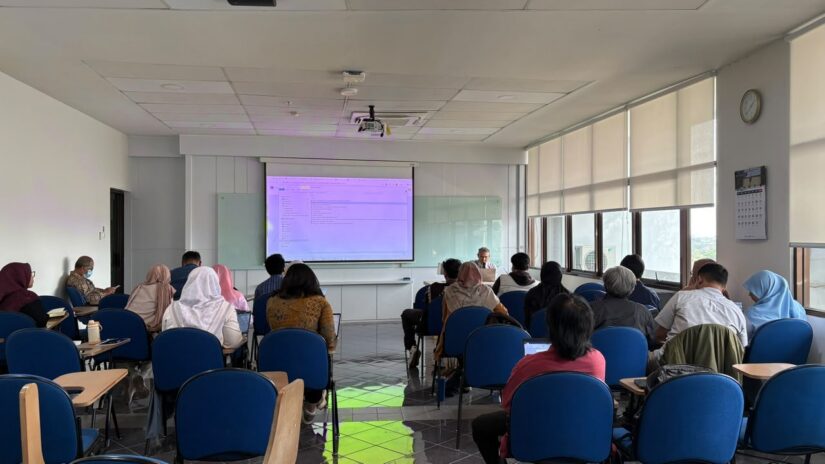
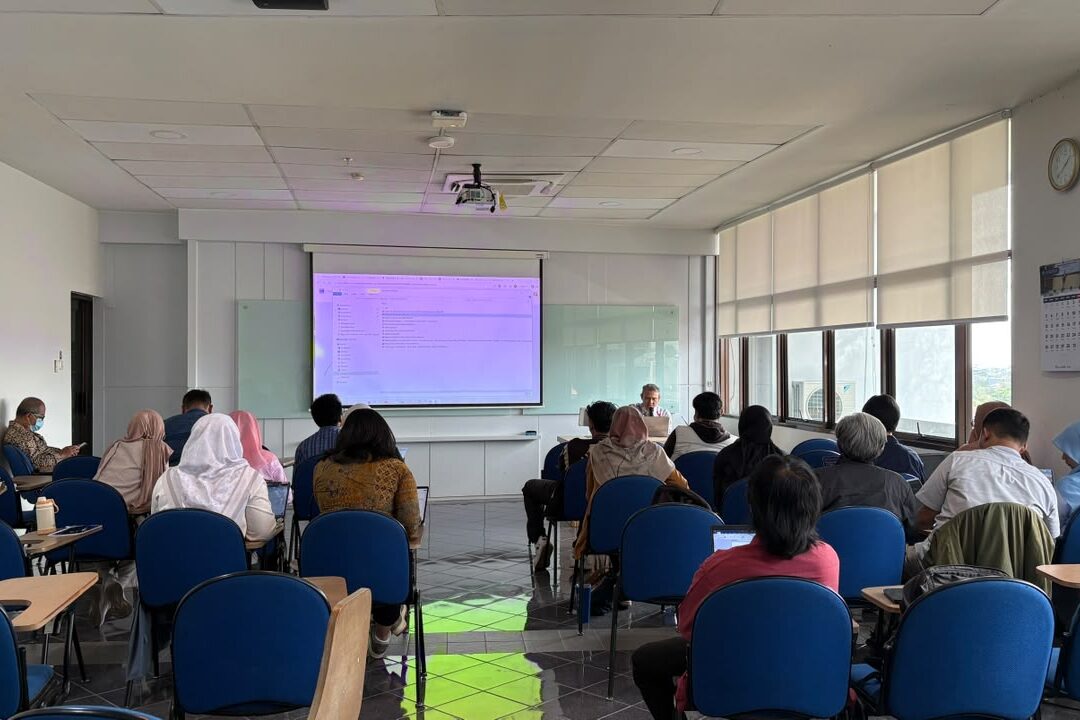
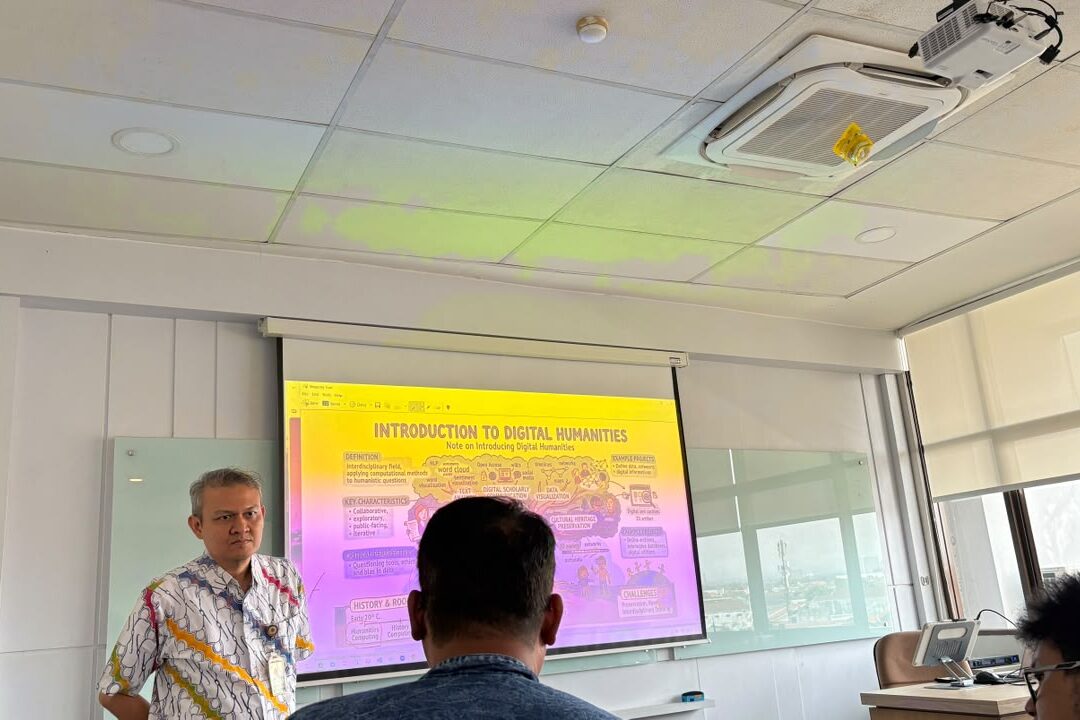
Yogyakarta, 5th October 2026 — How does digital technology influence the way people understand information and perceive social reality? This question was among the key topics discussed in the Discussion Series organized by the Media and Cultural Studies (KBM) Program, Graduate School of Universitas Gadjah Mada (UGM), entitled “Social Criticism in the Digital Era with the Concept of Digital Humanities.” Held in Room 406, 4th Floor, Unit 1 Building, UGM Graduate School, the event featured Prof. Ir. Nazrul Effendy, S.T., M.T., Ph.D. as the speaker.
The development of digital technology has generated various sources of information that can be used to understand society. Activities on social media, online news coverage, digital archives, and internet platforms contain traces of cultural change, communication patterns, and the ways social groups are represented. These developments create opportunities for humanities research to adopt methods capable of accessing and processing data on a much larger scale.
Digital Humanities was introduced during the discussion as an interdisciplinary approach that brings together humanities perspectives, digital technology, and computational methods. This approach showed research can extend beyond conventional reading and interpretation to incorporate text analysis, data visualization, digital mapping, and Natural Language Processing (NLP) to identify patterns across various digital sources.
These methods can help researchers identify trends and patterns in data. For example, analyzing large collections of news articles can reveal words frequently associated with particular social groups or changes in how an issue is discussed over time. Nevertheless, patterns identified with technology do not necessarily explain the entire phenomenon. Interpretation still requires an understanding of the social, cultural, and political contexts from the patterns it emerged from.
This perspective is important to non-exist competing interests in digital information. The production, collection, processing, and dissemination of information involve various actors and decisions that can influence what becomes visible and what remains overlooked. Data presented in the form of figures or graphs can also contain biases, depending on how the data are selected, categorized, and presented.
These issues are also connected to the role of algorithms in digital life. Algorithms can influence the content users encounter and shape their experiences when accessing information. Therefore, examining technology requires going beyond its technical mechanisms to question the interests underlying its use, who exercises control over it, and how it affects society.
This discussion for students of Media and Cultural Studies, offers a perspective for examining media and technology as integral parts of cultural dynamics. Digital technology can help identify patterns of representation and explain how information circulates. However, its use must be accompanied by the ability to critically examine the power relations that shape the production of meaning. Research should therefore go beyond identifying patterns to explore why they emerge and what implications they have for social life.
Ethics is another essential aspect of Digital Humanities. Information available on the internet cannot always be used without further consideration. Privacy, consent, information security, copyright, and the potential impact of research on individuals and groups must all be taken into account. Researchers must also consider how their findings are published to ensure that the presentation of information does not disregard context or harm the individuals and communities being studied.
Beyond supporting data analysis, digital technology enables research findings to be disseminated with various formats, including websites, digital archives, interactive maps, and data visualizations. These formats create opportunities for academic knowledge to reach wider audiences. However, the dissemination of knowledge must also take into account accessibility, data ownership, and communities’ rights to represent their own cultures.
This Discussion Series made the Media and Cultural Studies Study Program encourage students to develop their ability to use technology while maintaining a critical perspective on social change. Digital Humanities demonstrates how technology and data can expand research possibilities, while humanities perspectives help uncover the meanings, contexts, and power relations underlying them. Combining these approaches provides an important foundation for understanding digital society in a more comprehensive, reflective, and responsible manner.
Author: Khoirul Mujazanah