
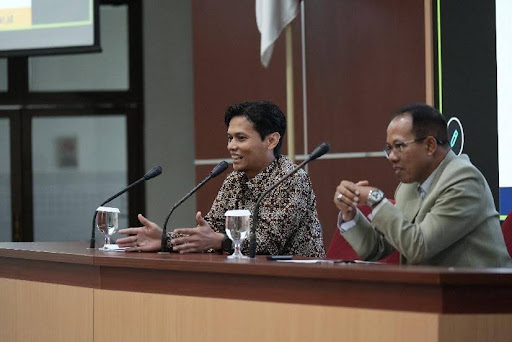
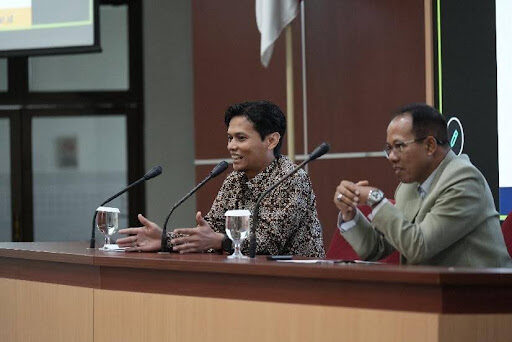
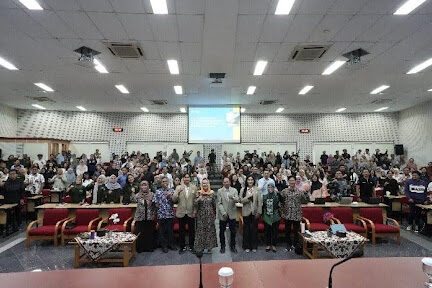
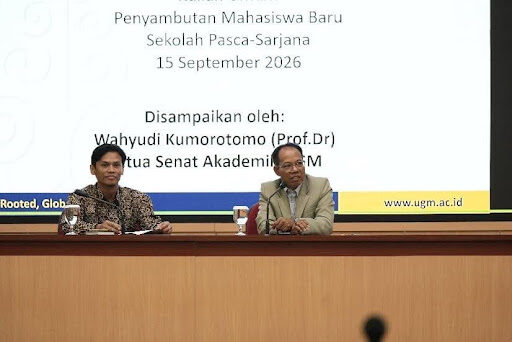
Yogyakarta, September 15th 2026 — The Graduate School of Universitas Gadjah Mada (SPs UGM) hosted an orientation public lecture for incoming master’s and doctoral students, focusing on strengthening institutional reputation and driving sustainable national progress. The session, held on-site at SPs UGM, featured the Chairman of the UGM Academic Senate, Prof. Dr. Wahyudi Kumorotomo, M.P.P., as the keynote speaker presenting on “The Role of the Graduate School and Transdisciplinary Approaches in Enhancing UGM’s Reputation and National Progress.” This address showed incoming students to align with SPs UGM’s vision and mission, internalize UGM’s core academic identity, and build an interdisciplinary research ecosystem.
Prof. Dr. Wahyudi Kumorotomo, M.P.P., in his presentation, highlighted that UGM’s identity is deeply rooted in its educational curriculum, which prioritizes holistic human development—fostering individuals who are intelligent, creative, communicative, cultured, environmentally conscious, and responsible. The historic adoption of Majapahit’s Prime Minister, Gadjah Mada, reflects a profound commitment to national unity across the Indonesian archipelago. These aspirations actualization showed UGM has outlined six strategic transformation agendas: (1) Planetary Health, Food, Security & Community Resilience; (2) Trans-disciplinary Knowledge & Integration; (3) Research to Impact & Responsible Innovation; (4) Civic University & Community Development; (5) Open Science, Research Integrity & Knowledge Commons; and (6) Global-Local Partnership & Academic Mobility.
Prof. Wahyudi also underscored the imperative role of transdisciplinary approaches in addressing complex national development challenges. Indonesia possesses immense potential for new and renewable energy (NRE) as a strategic commodity unique to the nation, its development frequently encounters operational failures. Citing the strategic solar panel (PV) policy in Rempang, he illustrated how project setbacks stemmed from a lack of dialogue with local communities and regulatory complexities surrounding land-use rights. This case emphasizes that strategic projects cannot rely solely on dominant economic and legal power structures, but must systematically integrate technological, social, demographic, and environmental dimensions.
Learning paradigms within the Graduate School, in line with institutional evolution, are transitioning from Teacher-Centered Learning to Student-Centered Learning, emphasizing the core 4C skills: Critical thinking, Creativity, Collaboration, and Communication. Wahyudi also addressed modern challenges surrounding Artificial Intelligence (AI) in academia. While AI serves as a powerful learning aid, academic achievement ultimately rests on authentic reasoning and the learning journey undertaken by students. Aligned with UGM’s academic guidelines, AI adoption must adhere to strict ethical standards to prevent over-reliance on generative AI, preserve academic integrity, and nurture critical thinking through constructive human-AI collaboration.
Prof. Wahyudi concluded with outline of five key takeaways for SPs UGM students: first, ensure that all academic pursuits and personal character embody UGM’s core identity; second, adopt transdisciplinary and multidisciplinary frameworks as foundational mindsets while cultivating strong teamwork habits; third, sustain UGM’s standing as a premier national institution through rigorous discipline and professionalism; fourth, utilize AI technologies responsibly anchored in uncompromising academic integrity; and fifth, maximize the engagement with faculty, administrative staff, and learning infrastructure across SPs UGM.