
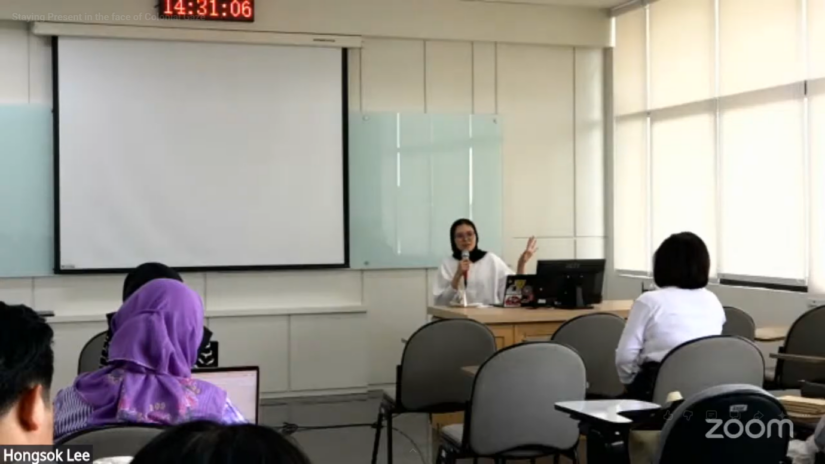
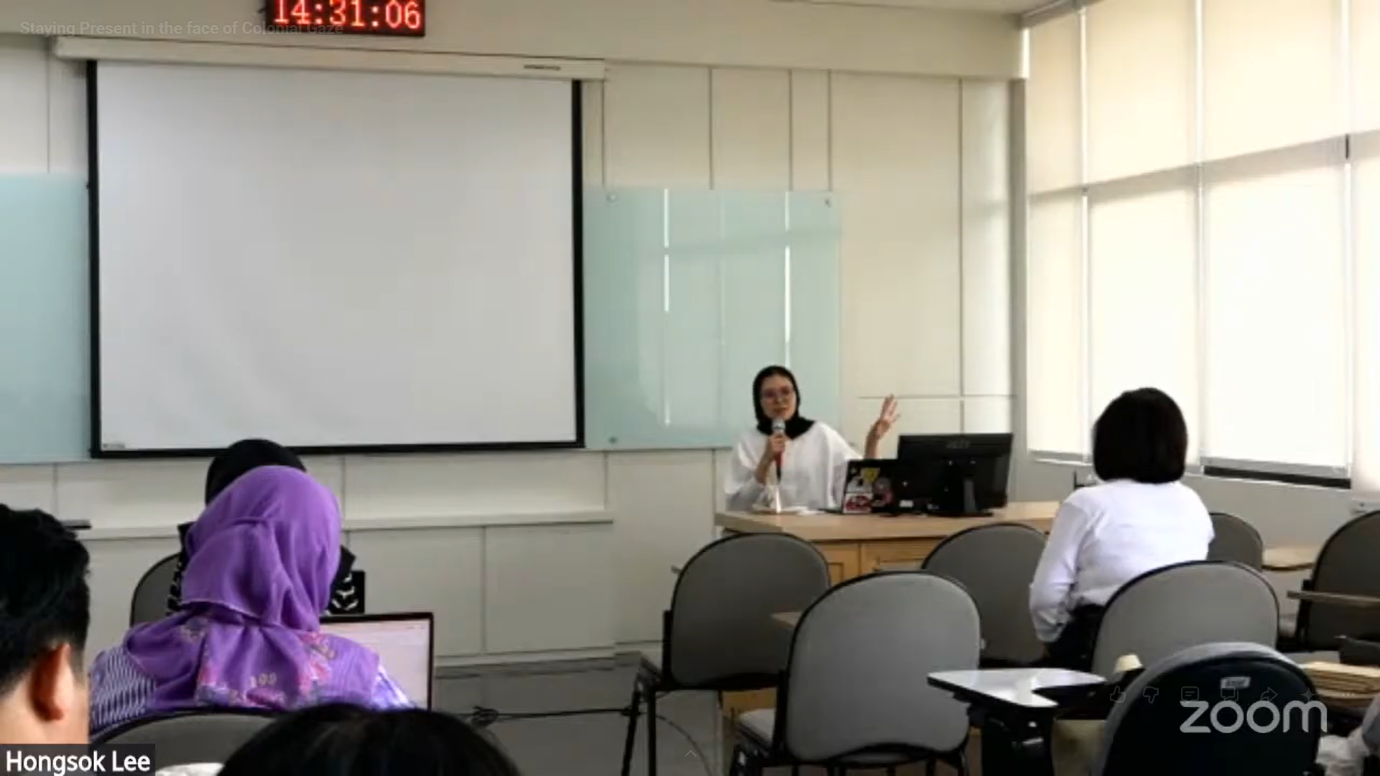
The Religion and Cross-Cultural Master Program (CRCS), Graduate School of Universitas Gadjah Mada (SPs UGM), once again hosted the Wednesday Forum on Wednesday, 2nd September 2026. Held in collaboration with the Inter-Religious Doctoral Program, the forum took place at Unit 1 Building, Graduate School of Universitas Gadjah Mada, featuring Ikrana Ramadhani, a graduate of the CRCS Master’s Program, as the speaker.
Ikrana presented her research entitled “Staying Present in the Face of Colonial Gaze: A Body Story” during the forum. Through her research, she invited participants to view the body not only as part of personal experience but also as a source of knowledge.
Ikrana traced her bodily experiences across different spaces and stages of life, including South Sulawesi, Yogyakarta, and Salzburg, Austria. According to her, changes in place and life experiences can bring previously unrecognized bodily responses to the surface. Sensations such as fear, shame, the desire to hide, as well as changes in posture and breathing, can provide important insights into how social, cultural, and religious experiences shape an individual.
“The body and the mind are not separate, and neither is superior to the other. They work together,” Ikrana explained when discussing the approach used in her research.
The body story approach shows Ikrana used bodily experiences as an entry point to understand how various social and religious structures can become embodied. She employed focusing and body writing techniques to pay closer attention to bodily sensations before assigning meaning to the experiences that emerged.
The discussion became more engaging as participants raised questions about the relationship of the body, trauma, identity, the hijab, and the process of producing academic knowledge from personal experience. Ikrana explained that her research was not solely an attempt at healing, but also a learning process aimed at understanding the body and its various responses.
“We are always learning how to listen to our bodies. It is just that now I have a greater understanding and awareness of how my body responds to something,” she said.
Ikrana also emphasized the importance of making space for bodily experiences within academic inquiry. According to her, the body can serve as a source of knowledge that enables a deeper understanding of human experience, including how power relations, social norms, and religious experiences are felt and lived in everyday life.
Writer: Asti Rahmaningrum