
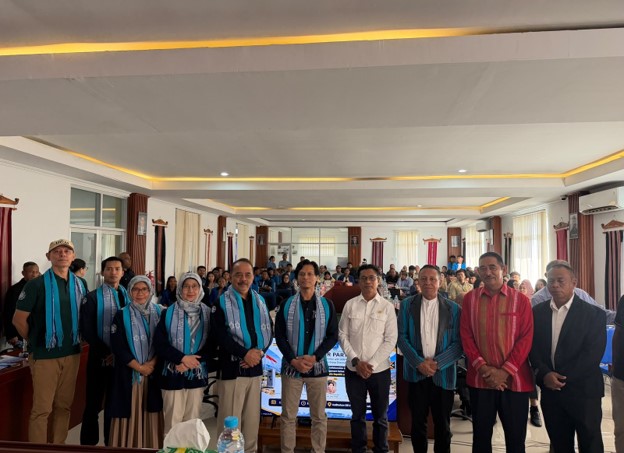
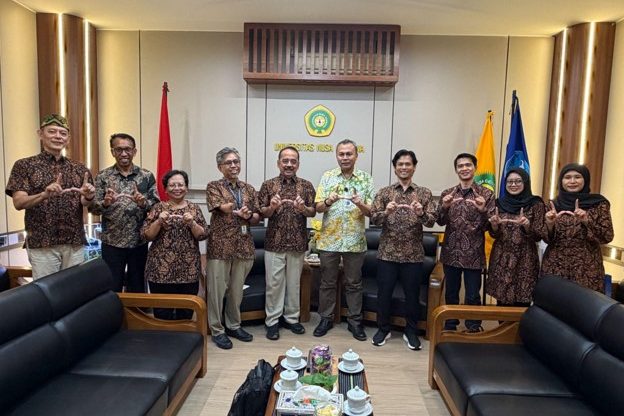
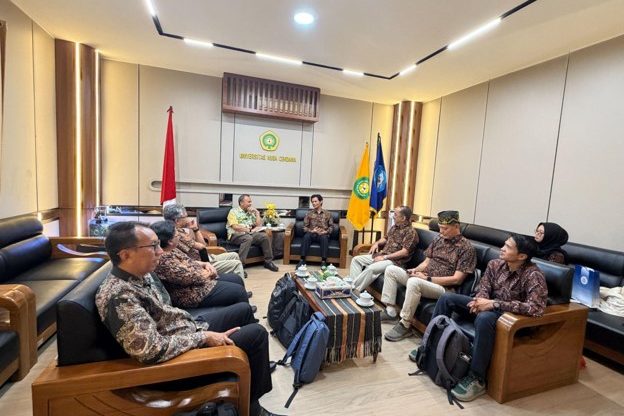
The Graduate School of Universitas Gadjah Mada (SPs UGM) held an official meeting with the leadership of Universitas Nusa Cendana (UNDANA) on Tuesday (July 14th) at the UNDANA Rectorate Building in Kupang. The meeting marked an important step to strengthen institutional collaboration and synergy in implementing the Three Pillars of Higher Education (Tri Dharma Perguruan Tinggi), encompassing education, research, and community engagement.
The SPs UGM delegation was led by the Vice Dean for Academic Affairs, Student Affairs, and Cooperation, Prof. Dr. Ir. Widyanto Dwi Nugroho, S.Hut., M.Agr.Sc., and was welcomed by the Vice Rector for Planning, Cooperation, and Information Systems of UNDANA, Prof. Dr. Philiphi de Rozari, S.Si., M.Si., M.Sc., Ph.D., and the Director of UNDANA Graduate School, Dr. Hamza H. Wulakada, S.P., M.Si.
Also joining the SPs UGM delegation were the Vice Dean for Finance, Assets, and Human Resources, Dr. techn. Khabib Mustofa, S.Si., M.Kom.; the Chief of the Geo-Information for Disaster Management and Spatial Planning Study Interest under the Environmental Science Master’s Program Prof. Dr. rer. nat. Junun Sartohadi, M.Sc.; the Coordinator for Research and Publication Quality Assurance, Ahmad Suparmin, S.P., M.Agr.Sc., Ph.D.; and the Head of the Master’s Program in Biomedical Engineering, Ir. Rini Dharmastiti, M.Sc.
SPs UGM, during the meeting, presented its Cross Border Partnership (CBP) program, one of the Graduate School’s flagship initiatives designed to foster collaboration of lecturers and researchers in conducting research and community engagement activities in the Indonesia–Timor-Leste border region. This program shows faculty members are entrusted with initiating and implementing collaborative projects in partnership with universities, local governments, and various stakeholders.
“We consider UNDANA a strategic partner with tremendous potential to jointly advance education, research, and community engagement in border areas. We hope this collaboration will generate tangible benefits not only for both institutions but also for the communities they serve,” said Prof. Widyanto.
The CBP program focuses on four major clusters: science and technology, health, agro-complex, and social sciences and humanities. These thematic clusters are expected to produce innovative solutions to address development challenges in border areas and contribute to the improvement of community welfare.
The Vice Rector for Planning, Cooperation, and Information Systems of UNDANA, Prof. Dr. Philiphi de Rozari, welcomed the initiative and emphasized that border regions face multifaceted challenges requiring collaborative efforts from various sectors.
“Border issues deserve serious attention, not only in land border areas but also in maritime regions. We hope to establish a sustainable partnership with SPs UGM to support the development of border areas and deliver meaningful benefits to local communities,” he stated.
Author: Asti Rahmaningrum