
The Center for Religious and Cross-cultural Studies (CRCS), Graduate School of Universitas Gadjah Mada (UGM), regularly organizes its Wednesday Forum as a platform for academic dialogue. This forum, CRCS UGM continues to bring together diverse perspectives to critically and interdisciplinarily discuss issues related to religion, culture, history, and society.
The Wednesday Forum held on Wednesday (May 20) at the UGM Graduate School Building Unit 1 featured Hudaya Kandahjaya, a researcher and scholar who has devoted decades to the study of Buddhism and Borobudur. The session explored the theme, “How Should Borobudur Be Understood?”
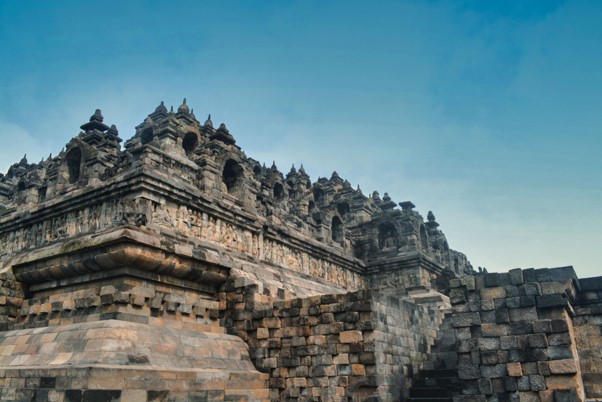
Hudaya, in his presentation, encouraged participants to view Borobudur as a coherent whole rather than fragmented interpretations that have often emerged over time. According to him, as the world’s largest Buddhist monument, Borobudur is a monumental masterpiece characterized by an organized, systematic, and harmonious design. Nevertheless, interpretations of the monument have long been marked by differing views, ranging from its rediscovery to the meaning and symbolism of the entire structure.
Hudaya explained that many studies on Borobudur have focused only on specific aspects of the monument or relied on assumptions that are not adequately supported by evidence. As a result, such interpretations often fail to explain Borobudur as an integrated and comprehensive work.
“Borobudur contains various interconnected features and cannot be reduced to a single aspect. Understanding the monument requires an approach examining its overall structure and the relationships among its elements,” he said.
A graduate of Applied Statistics from IPB University, Hudaya has studied Borobudur for several decades. After translating David J. Kalupahana’s Buddhist Philosophy in 1986, he actively wrote and published works on Borobudur and Indonesian Buddhism. Among his most notable publications is The Master Key to Borobudur Symbolism, released in 1995. In 2025, he also contributed an entry on Borobudur to the Oxford Encyclopedia of Buddhism.
During the forum, Hudaya emphasized the importance of rigorous research methodology and careful data analysis in understanding Borobudur. He argued that a comprehensive approach has helped researchers avoid anachronistic speculation and revealed the ideas, knowledge, and skills of Borobudur’s creators, who successfully integrated its many features into a harmonious whole.
Author: Asti Rahmaningrum