
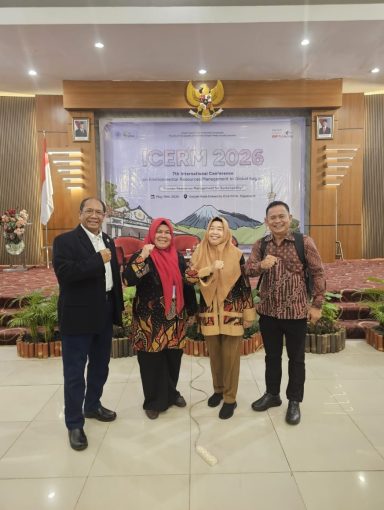
YOGYAKARTA – Global challenges triggered by climate change, declining environmental carrying capacity, increasing pressure on natural resources, and socio-economic transformations are making population issues increasingly complex for the future. Addressing this major homework, Universitas Gadjah Mada held its prestigious annual conference, the International Conference on Environmental Resources Management in Global Region (ICERM), which officially entered its 7th iteration this year. Held on Tuesday, May 19th, 2026, this international conference carried the crucial theme, “Human Resources Management for Sustainability.” The 7th ICERM’s strategic theme is expected to serve as a scientific forum that generates promotion and mitigation benchmarks, while also becoming a valuable blueprint for policymakers to enrich knowledge and raise broader public awareness.
As part of the academic community focusing on population dynamics, students of the UGM Population Master Program actively participated by contributing tactical thoughts with two strategic scientific papers. The first paper, titled “Urban Agglomeration Resilience in Java and Its Implication for Regional Development Policy,” was a collaborative work by Armadi Setyo Pambudi and Suci Retno Ningtiyas. This study highlighted urban and regional resilience on Java Island using the Agglomeration Resilience Index (ARI) calculation, which integrates demographic, socio-economic, infrastructural, and environmental dimensions. The results showed a surprising finding: the regions obtaining the highest resilience scores were actually neither the national capital nor the provincial capitals traditionally known as economic engines. Meanwhile, the second paper, which was equally sharp, was written by Lambang Haris Wijayanto with the title “Ecological Pressure Beyond Population Growth: Waste Intensity, Management Capacity, and Policy Implications in Central Java, Indonesia.” This paper dissected in depth how ecological pressure in Central Java is triggered by waste intensity and management capacity beyond the factor of population growth.
This scientific forum gained even more weight with the presence of a lineup of international speakers who brought comprehensive perspectives on future mitigation and resilience to achieve the Sustainable Development Goals (SDGs) targets. An in-depth presentation was delivered by Prof. Dr. S Suriyanarayaan, M.Sc., M.Phil., Ph.D. regarding the importance of the Blue Green Infrastructure concept, which based on three main pillars: adaptation and mitigation, health and well-being, and urban resilience. He also reminded the audience of the high price of environmental degradation that humans must bear due to a reliance on “Grey” Infrastructure, or conventional physical development.
Empirical insights regarding regional risk and disaster management were reinforced by Dr. Abdul Haris Achadi, S.H., DESS of the Secretariat General of the National Search and Rescue Agency (Basarnas). He shared the urgency of regulatory and human resource resilience in facing increasingly complex disaster scenarios due to climate change. Complementing this perspective, Dr. Khamarrul Azahari Bin Razak from the Disaster Preparedness and Prevention Center (DPCC) at Universiti Teknologi Malaysia Kuala Lumpur presented innovations and preventive strategies in community-based disaster management across the Southeast Asian region. This synergy of ideas from experts and the tangible contributions from the Master of Population Program, the UGM Graduate School has proven its commitment not to merely be an academic ivory tower, but a driving engine for real solutions toward a more sustainable future for the planet.
Author: Suci Retno Ningtyas
Editor: Siti Muyasaroh