
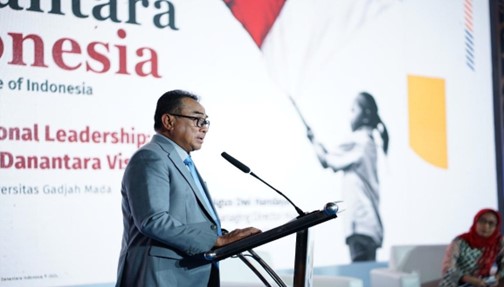
Yogyakarta, 11th November 2025 — Leadership Day 2025, organized by the Graduate School of Universitas Gadjah Mada (SPs UGM) through the Leadership and Policy Innovation (MDKIK) Master and Doctoral Program, together with the Alumni Association of the Master’s and Doctoral Program in Leadership and Policy Innovation (Kapimgama), presented its second keynote speech featuring an inspiring talk by Agus Dwi Handaya, Managing Director of Holding Operational Danantara Indonesia, titled “Transformational Leadership: Learning from the Danantara Vision.” In his presentation, Agus highlighted the importance of leadership transformation within Indonesia’s state-owned enterprises (BUMN) as the driving force of change that directly contributes to public welfare.
He began by emphasizing the strategic role of BUMN not only as the backbone of the national economy but also as an agent of social development. “BUMN collectively hold assets worth over ten thousand trillion rupiah, employ 1.6 million people, and serve millions of citizens daily. These figures are not mere statistics — they represent a vast responsibility to enhance the nation’s prosperity,” he said.
However, behind this immense potential, Agus acknowledged the challenges that still persist, from overlapping policies and mismanagement to inefficiencies that hinder optimal performance. These issues, he explained, were among the main reasons behind the establishment of Danantara Indonesia, initiated by the government as a new chapter in transforming BUMN toward more professional and sustainable governance. “Danantara is not just a new institution; it represents the spirit of change. We exist to ensure BUMN undergoes a fundamental transformation — from rigid bureaucracies into dynamic, value-driven corporations,” he stated.
Agus went on to outline four key pillars of BUMN transformation: business transformation, governance transformation, service transformation, and leadership transformation. These four pillars serve as the foundation for systemic reform supporting prioritizes efficiency, transparency, and visionary leadership. “Transformation is not merely about business restructuring — it’s about transforming mindsets. BUMN must exemplify how integrity-driven leadership can simultaneously create social and economic value,” he asserted.
He then described the two core DNAs of transformational leaders within Danantara: professionalism and nationalism. Professionalism, he said, reflects commitment to expertise, ethics, and accountability, while nationalism is embodied in dedication and a sense of duty to the nation. “Transformational leadership is not about position or personal achievement, but about the highest form of service, sacrifice, and fundamental change for the greater good of the country,” he emphasized.
In addition, Agus introduced the 3S and 3N principles guiding Danantara’s organizational philosophy — Strategic, People, Business, Risk (3S) and Nagih, Nuntun, Nata (3N) — reflecting adaptive and results-oriented leadership. Danantara, through this approach, aims to transform every BUMN employee into an agent of change — not only competent but also imbued with integrity and a strong national spirit.
This session served as a vital reflection for participants of Leadership Day 2025, reaffirming that transformation in both public and corporate sectors requires leadership that goes beyond managerial intelligence — leadership grounded in values of service and national morality.
With this spirit, Leadership Day once again emphasized that leadership is not merely about power, but about the ability to create value and cultivate trust. From the UGM campus, the story of Danantara’s transformational leadership stands as a living inspiration for nurturing leaders who serve with heart and think for Indonesia’s future.
Writers: Naufal Sabda Auliya and Rosyida Indah Mawarni
Editor: Arfikah Istari