
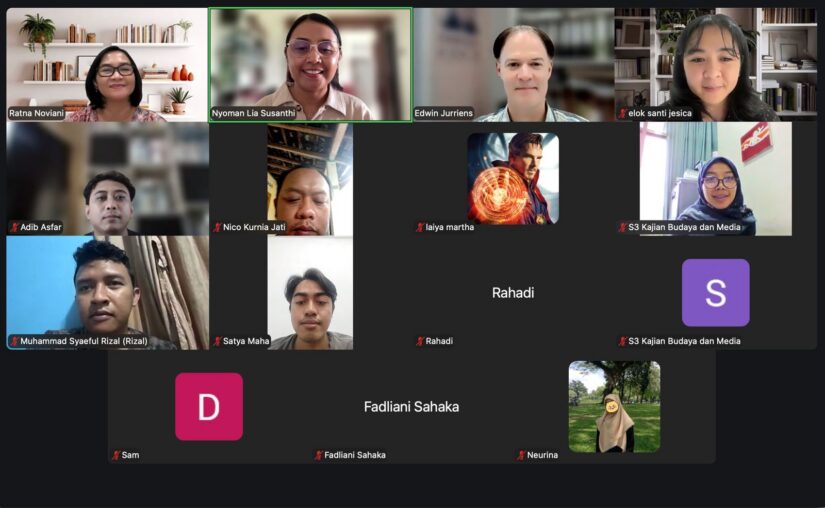
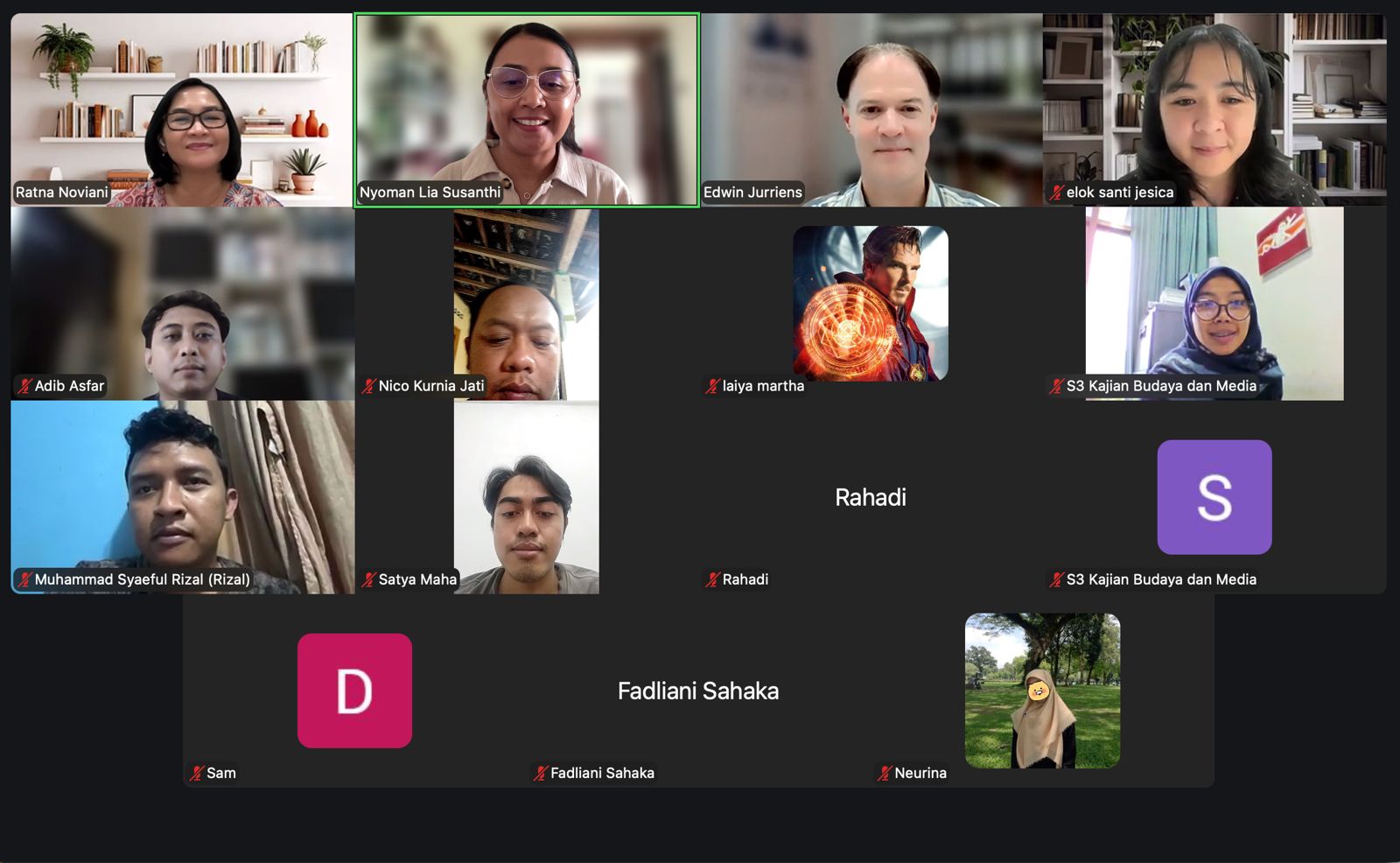
Yogyakarta, 18 November 2026 – The Media and Cultural Studies Master and Doctoral Programs (MCS), Graduate School, Universitas Gadjah Mada (UGM), held a KBM Discussion Series entitled “Instalogic-Fair: The Political Economy Strategies of Art Fairs on Instagram” on Wednesday (18/11). Conducted online via Zoom Meeting, the event featured two speakers: Dr. Elok Santi Jesica, S.Pd., M.A., a lecturer in the Media and Cultural Studies Program at UGM, and Associate Professor Dr. Edwin Jurriëns from the Asia Institute, Faculty of Arts, The University of Melbourne. The discussion was conducted in a bilingual format (Indonesian and English) and moderated by Nyoman Lia Susanthi, S.S., M.A., a doctoral student in Media and Cultural Studies at UGM.
The first presentation was delivered by Dr. Elok Santi Jesica under the title “Instalogic-Fair: The Political Economy Strategies of Art Fairs on Instagram.” Drawing on Art Jakarta as a case study, Dr. Elok examined how Instagram has transformed the strategies and operations of art market institutions. The rapid growth of art fair accounts on Instagram served as a starting point for understanding how art institutions utilize social media to build visibility, attract public attention, and expand their market reach.
Dr. Elok In her research used three main theoretical frameworks: Pierre Bourdieu’s Field of Cultural Production, Karl Polanyi’s Market as an Institution, and Stig Hjarvard’s theory of mediatization. These frameworks were used to analyze the relationship of symbolic power, market construction, and the transformation of art institutions with digital media. Using a multisited ethnography approach across online and offline settings, the study showed that art fairs have evolved beyond spaces that merely facilitate art transactions into institutions that prioritize visibility and the attention economy.
Dr. Elok introduced the concept of Instalogy, a configuration of Instagram logic, market logic, aesthetic logic, and practical negation that shapes the practice of Instalogic-Fair. In practice, Art Jakarta employs various strategies with spatial and temporal interventions, as well as visual curation. One example can be seen in the 2023 edition of Art Jakarta, themed “Fresh Start, Fresh Page,” in which the color lemon yellow was extensively used across its Instagram account, billboards, and exhibition walls to encourage visitors to engage with the space and take photographs from the moment they entered the venue.
Furthermore, Art Jakarta builds public anticipation by showcasing the activities of VIP guests before the exhibition opens to the general public. Behind the seemingly democratic and open atmosphere of the exhibition lies a de-differentiation strategy that subtly maintains hierarchies with the arrangement of VIP and non-VIP areas, information channels, collector categorization, and audience segmentation. According to Dr. Elok, this process of mediatization enables Art Jakarta to bring together Bourdieu’s traditionally opposing poles of cultural production: the autonomous pole and the heteronomous pole. Audiences are no longer merely visitors; they also participate in producing and distributing information that expands public attention toward art market institutions.
The next session featured Associate Professor Dr. Edwin Jurriëns, who presented “Art in the Age of Digital Self-Portraiture: Transforming Spaces, Positions and Bodies.” In his presentation, Prof. Edwin emphasized the importance of critically reflecting on the development of digital technology, social media, and artificial intelligence, particularly in relation in changing artistic practices and experiences in society.
Prof. Edwin appreciated Dr. Elok’s research and suggested that the study could provide an important foundation for developing an alternative art historiography. Rather than focusing exclusively on art objects or artists’ biographies, this approach examines how people’s ways of using and perceiving spaces, bodies, roles, and positions change with their interactions with artworks.
Prof. Edwin in discussing the Indonesian visual arts ecosystem, identified various actors and institutions, including national and regional art museums, auction houses, commercial galleries, art fairs, biennales and triennales, as well as independent art studios and collectives. He highlighted the limited availability of comprehensive national art museums in Indonesia, which has enabled art fairs such as Art Jakarta to play a significant role in representing Indonesian art on a global stage. Meanwhile, artworks acquired through auction houses and commercial galleries often enter private collections, potentially leaving them inadequately documented in the historical memory of Indonesian art.
These changes in the art ecosystem are also marked by the growing influence of young collectors. Beyond relying on financial capital, they build social and symbolic capital with curatorial knowledge and practices of self-documentation on social media. Prof. Edwin also traced the dynamics of artistic collectivism in Indonesia, from communal traditions in the 1950s and 1960s, with the emphasis on individual aesthetics during the New Order era, to the resurgence of participatory art and performance art following the Reformasi period with contemporary independent collective spaces.
Furthermore, Prof. Edwin discussed the changing relationship of bodies, artworks, and exhibition spaces. Whereas photography was often restricted in galleries in the past, many exhibitions today are designed to be interactive and social-media-friendly. This phenomenon raises questions on Instagram art, referring to artworks or installations deliberately designed to gain exposure with social media. This shift also redirects attention from the artwork itself toward the relationship of the artwork and the body of the admirer.
Prof. Edwin critically examined self-glorification and narcissism on social media, and introduced a comparison of the concepts of flâneur and badaud. Both describe different ways of observing public spaces: the flâneur observes the environment from a critical distance, while the badaud becomes immersed and captivated by the surrounding visual environment. This comparison opens up further reflection on how individuals position themselves and construct visual experiences within digital culture.
The discussion also featured an examination of several works by Indonesian artists responding to developments in technology, media, and social life. These included Priyanto Sunarto’s caricature “Seniman” (1976), Heri Dono’s installation “Kuda Binal” (1992), Agan Harahap’s parody “Maka lahirlah Angkatan 66” (2017), and Wimo Ambala Bayang’s work “Angkatan Keduabelas” (2008).
Through this KBM Discussion Series, the Media and Cultural Studies Program at UGM provided a platform for intellectual exchange, bringing together academic perspectives on the political economy of the art market, mediatization, and the transformation of artistic practices in the digital era. The discussion also underscored the importance of critically examining technological and social media developments, not merely as tools for distributing artworks, but as forces reshaping relationships of art institutions, artists, collectors, and audiences.
Author: Khoirul Mujazanah