
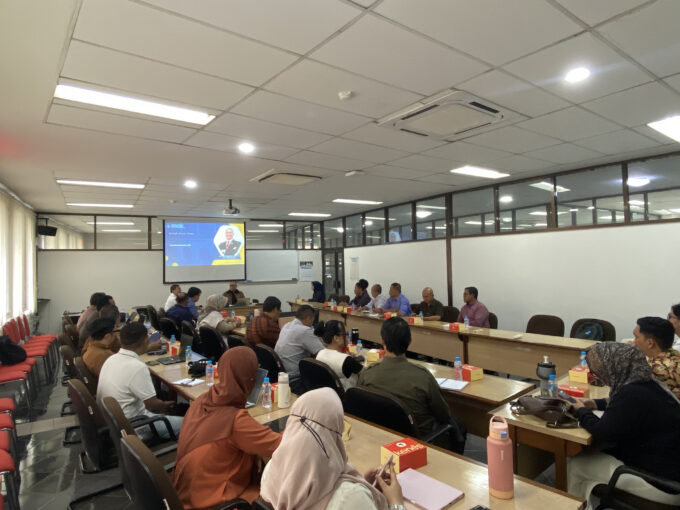
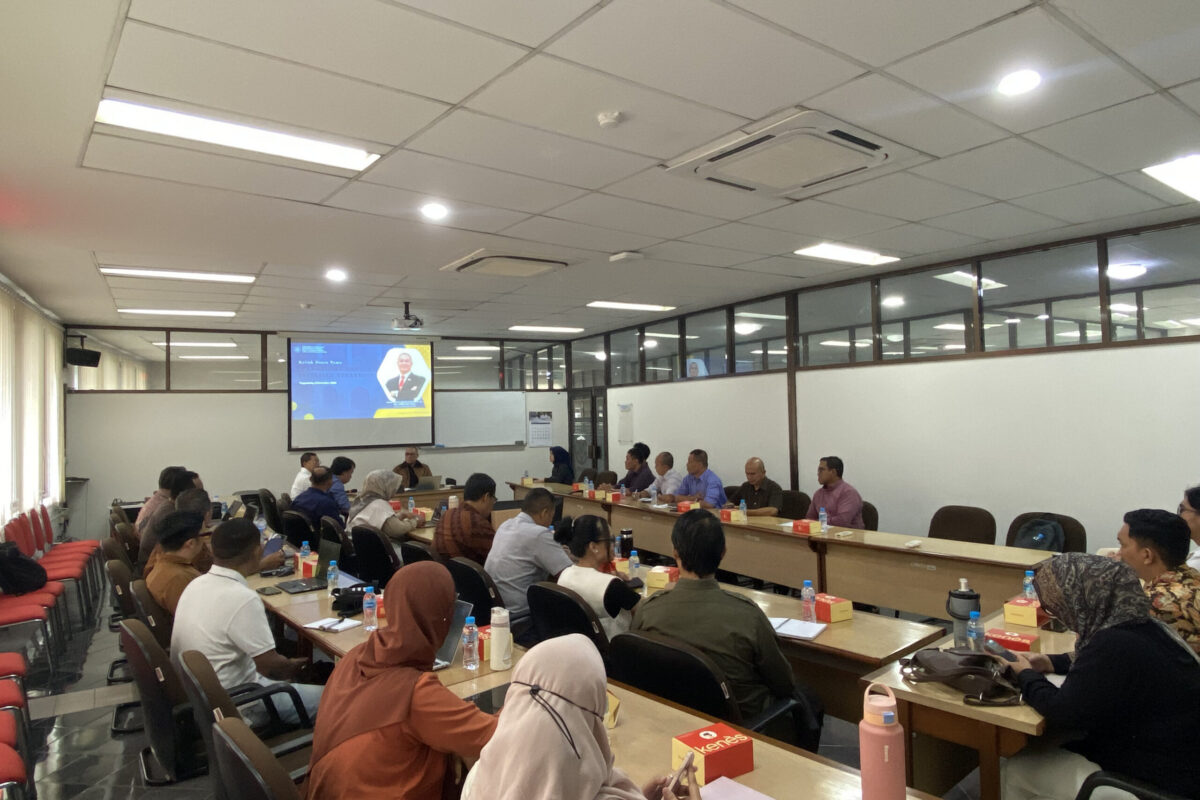
Yogyakarta, November 6th 2026 – The National Resilience Doctoral Program Graduate School of Universitas Gadjah Mada (UGM), held a guest lecture entitled “Paradigms and Strategic Intelligence” at Meeting Room A, UGM Graduate School Building. The event featured Rear Admiral Dr. Ivan Yulivan, S.E., M.M., M.Tr. (Han), M.Tr. (Opsla), former Governor of the State Intelligence College (STIN), who discussed the concepts, analytical approaches, and applications of strategic intelligence in the context of national resilience.
The guest lecture commenced with opening remarks by the Chief of the National Resilience Doctoral Program, Prof. Priyono Suryanto, S.Hut., M.P., Ph.D. The event was attended by doctoral and master students from the National Resilience programs, as well as students from the Peace and Conflict Resolution concentration. The lecture was delivered in two sessions, covering intelligence paradigms and theories with their application in analyzing strategic issues.
In the first session, Dr. Ivan discussed the history and practice of intelligence, the distinction of intelligence and counterintelligence, behavioral analysis, and intelligence products. He emphasized that trust is a fundamental element of intelligence activities and serves as the basis for subsequent actions. He also highlighted the role of intelligence as an early warning system for identifying potential threats to national sovereignty, territorial integrity, and public safety.
The discussion also addressed cyber threats amid technological advance and digital transformation. Dr. Ivan further explored developments in artificial intelligence (AI), which have enhanced the capabilities of various strategic and autonomous weapons systems.
In the second session, Dr. Ivan explained the criteria that determined information classification as strategic. According to him, the strategic value of information is not determined solely by its level of confidentiality, but also by its potential impact on national interests.
“Information is considered strategic when its underlying content involves threats, changes, or prosperity, and influences national interests,” Dr. Ivan explained.
He further outlined the broad scope of strategic intelligence, encompassing political, geopolitical, defense, economic, resource, technological, cyber, social, information, environmental, and health sectors. He also introduced three interconnected dimensions of intelligence: knowledge, organization, and activities. The knowledge dimension refers to the outcomes of information processing and assessment based on evidence, reasoning, and relevance. The organizational dimension concerns mandates, personnel, resources, and accountability,while the activities dimension encompasses the processes of acquiring, processing, and utilizing information.
Dr. Ivan illustrated its practical application with a scenario involving energy supply disruptions caused by a conflict that obstructs distribution routes. The example demonstrated how information about distribution barriers can be analyzed to assess potential impacts on national energy availability, and identifying alternative suppliers therefore the contingency measures should the disruption persist.
Furthermore, he outlined the intelligence cycle, which consists of determining information requirements, collection, processing, analysis, dissemination, and feedback. This cycle is dynamic rather than strictly linear, as new information may emerge at any stage. Therefore, source reliability, collection methods, and sound reasoning are essential in ensuring information as a reliable basis for assessment and decision-making.
The discussion also highlighted the role of intelligence in identifying potential threats, assessing vulnerabilities, and estimating their possible impacts on the state. “When we talk about intelligence, we are always looking for threats,” Dr. Ivan remarked. In this regard, intelligence analysis goes beyond identifying threats to include assessments of potential losses, risks, and consequences for national resilience.
Dr. Ivan, as part of the discussion on national resilience, also introduced the concept of Astagatra, which consists of Trigatra and Pancagatra. Trigatra comprises geography, natural resources, and demography, while Pancagatra encompasses ideology, politics, economy, socio-culture, and defense and security. The interconnections of these dimensions are essential considerations in understanding vulnerabilities and analyzing the potential consequences of threats to national resilience.
Author: M. Naufal Majid
Editor: Yeti Susilowati