
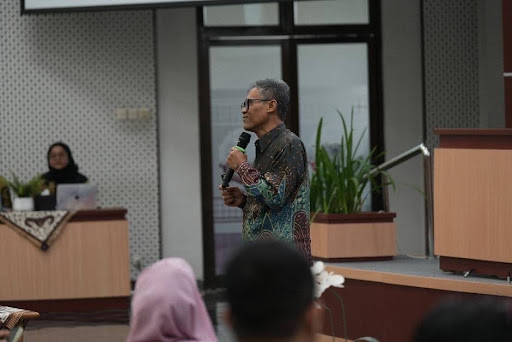
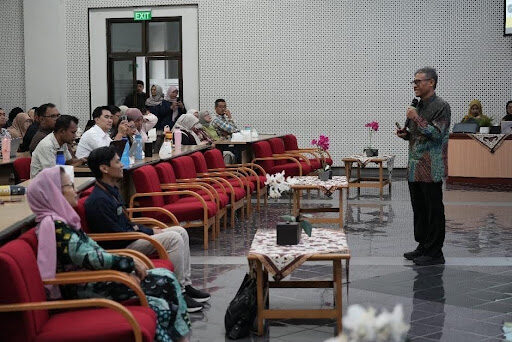
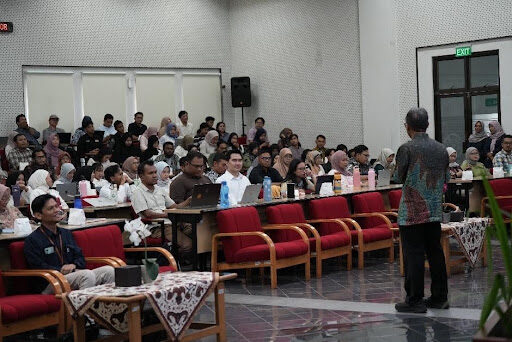
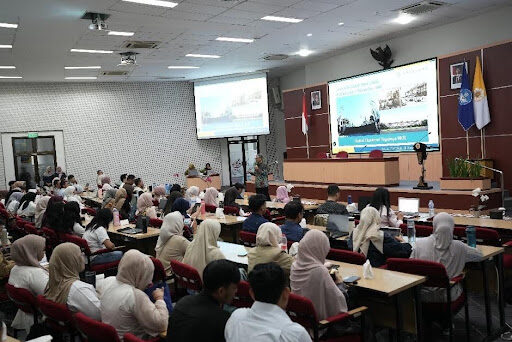
Yogyakarta, September 16th 2026 — The Graduate School of Universitas Gadjah Mada (SPs UGM) hosted the second day of its orientation program for new master and doctoral students for the 2026/2027 Academic Year. Commencing at 08:00 WIB, the opening session focused on “Introduction to UGM Values,” delivered by the Chief of the UGM Board of Professors, Prof. Ir. Panut Mulyono, M.Eng., D.Eng., IPU, ASEAN Eng. The session was structured to endow new graduate students with a profound understanding of UGM’s institutional identity, scientific integrity, and the strategic role of postgraduate research in addressing national challenges.
Prof. Ir. Panut Mulyono emphasized that Universitas Gadjah Mada serves as a historic symbol of the Unitary State of the Republic of Indonesia (NKRI), established as the nation’s first public university following independence. The state has entrusted UGM with a five-fold national mandate operating with academic avenues: Philosophical, Historical, Juridical, Sociological, and Operational Mandates. To fulfill the nation’s comprehensive needs, UGM maintains a steadfast commitment to academic excellence through three core pillars: personality development, academic advancement, and cultural preservation. This aligns with UGM’s vision to pioneer as a world-class national university that is excellent, innovative, and dedicated to the nation’s interests based on Pancasila. As mandated in Government Regulation No. 67 of 2013 regarding the UGM Statute (Article 4), UGM aims to establish a national institution that instills cultural values and shapes moral individuals who possess acute awareness and responsibility for the welfare of Indonesia and the global community.
Prof. Panut elaborated that attaining World-Class University status requires three essential prerequisites: strong organizational governance, exceptional human talent, and adequate funding. All core bodies within UGM collaborate to create these standards with the Higher Education Tri Dharma framework. Furthermore, UGM embodies a continuous spirit of transformation, evolving from a Classical University (teaching-oriented) to a Research University, an Entrepreneurial University, and currently a University 4.0 focusing on socio-economic impact, inclusive innovation, and the Sustainable Development Goals (SDGs). Prof. Panut noted that graduate students play a pivotal role in fulfilling UGM’s research mandate by generating relevant, novel knowledge articulated through their final theses.
Academic ethics, beyond institutional growth, created a central theme of the address. Prof. Panut asserted that scientific inquiry strictly forbids data fabrication, noting that true academic values are inherently noble, universal, and empirical. UGM values serve as a moral compass guiding the academic community to uphold strict academic integrity. This organizational ethos is further reflected in UGM’s physical and cultural philosophy of “Cemara Tujuh” (PITU), comprising Pitutur (counsel), Pituduh (guidance), and Pitulungan (assistance), which form the bedrock of mutual cooperation (gotong royong) across the campus community.
Prof. Panut Mulyono, concluding his address, shared an insightful parable based on the narrative of Prophet Moses (pbuh) and Prophet Khidr (pbuh), imparting three fundamental lessons for graduate scholars: first, remain humble and open to learning from anyone possessing greater knowledge regardless of their status; second, cultivate relentless intellectual curiosity in pursuit of truth; and third, engage in beyond logical thinking—looking beyond conventional logic to incorporate moral values, ethics, and wisdom when evaluating complex societal issues.
Author: Nadia Fadlillah D.
Editor: Berlian B.