
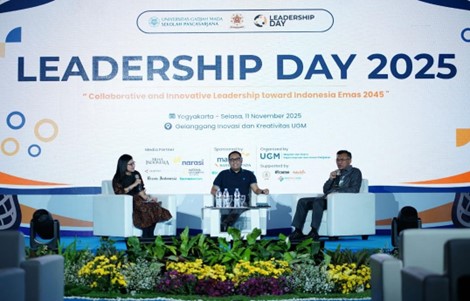
Yogyakarta, 11th November 2025 — The final session of Leadership Day, organized by the Graduate School of Universitas Gadjah Mada (SPs UGM) through the Leadership and Policy Innovation (MDKIK) Master and Doctoral Program in collaboration with the Alumni Association of the Leadership and Policy Innovation Program (Kapimgama), featured a talk show titled “Youth Leadership: Empowering the Next Generation.” The session served as a platform for reflection and inspiration for young generations to understand the essence of leadership in the era of disruption.
The discussion brought together two speakers representing different fields but sharing the same spirit: Pramudya Iriawan Buntoro, President Director of BPJS Ketenagakerjaan, and Willy Sakareza, Director at Traveloka Indonesia.
The moderator opened with a key question about the essential skills and characteristics young leaders must have to remain relevant, impactful, and fair. Responding to this, Pramudya Iriawan Buntoro emphasized that today’s young generation lives amid rapid change, demanding adaptability and strong communication skills.
“For leaders in this fast-paced, tech-driven generation, adaptability and the ability to listen and communicate effectively are crucial to building engagement,” he said.
He added that leadership success in an intergenerational workplace also depends on understanding the differences between generations.
“Gen X, who are known for their hard work, often meet Gen Z, full of ideas yet sometimes confused,” he remarked reflectively, describing the dynamics often found in today’s work environments.
Meanwhile, Willy Sakareza from Traveloka highlighted the key traits needed by the new generation of leaders include critical thinking, creativity, and resilience.
“The average age of Traveloka employees is 28. The qualities we value are critical thinking, endurance, and creativity — being problem solvers both individually and as a team,” he explained.
He also shared an interesting story about how the company entrusts young people with major responsibilities early in their careers.
“There was an intern who even received a job offer from another company,” he said, underlining how such opportunities demonstrate the importance of giving young people the space to learn and grow.
The open and inspiring dialogue made both speakers agree that the future of leadership is no longer determined by age or title, but by the ability to continuously learn, adapt, and collaborate based on human-centered values. The talk show emphasized that young people are vital pillars for the nation’s leadership continuity. They are expected not only to think critically and innovatively but also to lead with empathy and social awareness.
The Graduate School of UGM with the spirit of Leadership Day 2025, — through its Leadership and Policy Innovation (MDKIK) Master’s and Doctoral Program — reaffirms its commitment for preparing young leaders who are adaptive, collaborative, and future-oriented. These are leaders who are not only ready to face challenges but also capable of creating opportunities for meaningful change.
Writers: Naufal Sabda Auliya and Rosyida Indah Mawarni
Editor: Arfikah Istari