
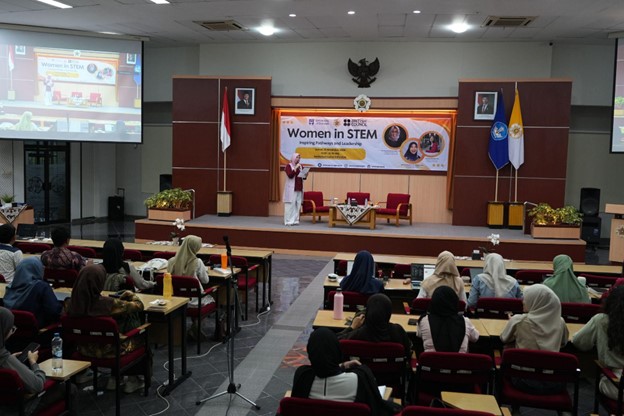
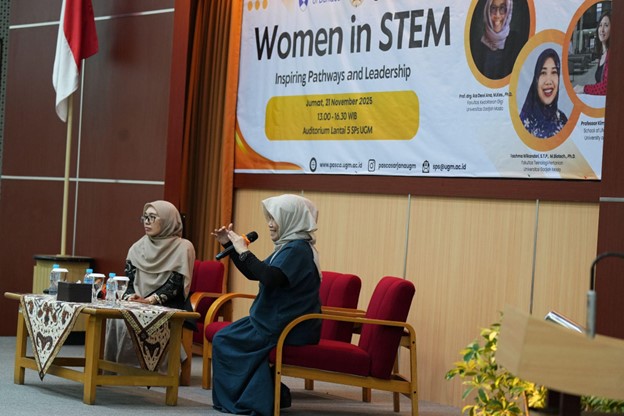
Yogyakarta, 21/11/2025 — The Graduate School (SPs) of UGM held an academic activity titled Women in STEM: Inspiring Pathways and Leadership on Friday, 21st November 2025, in the 5th-floor Auditorium Room, UGM Graduate School.
This event presented three speakers from within and outside the country, namely Prof. drg. Ika Dewi Ana, M.Kes., Ph.D from the Faculty of Dentistry UGM, Rachma Wikandari, S.T.P., M.Biotech., Ph.D from the Faculty of Agricultural Technology UGM, and Professor Kim Dale, Ph.D from the School of Life Sciences, University of Dundee.
This activity aimed to create a sharing space for inspiration and deep reflection on the journey of women in science, technology, engineering, and mathematics, especially in the context of academic leadership and global research.
The first session was delivered by Prof. drg. Ika Dewi Ana, M.Kes., Ph.D with a presentation titled “From Bench to Policy: A Case of Translational Research in Carbonate Apatite-Based Tissue Engineering and Regenerative Medicine.”
Prof. Ika presented the long journey of translational research in developing carbonate apatite as a biomaterial for tissue engineering and regenerative medicine. She emphasized the importance of mimicking extracellular matrix structures as the key for successful tissue regeneration.
The research group she leads succeeded in producing various biomaterial products, such as Gondrap and regenerative sponges, now used in national medical practice. Even though, optimization is still being carried out before they are marketed more widely.
Prof. Ika highlighted several clinical challenges, especially infection due to acidic tissue environments, limitations on the use of antibiotics, and cases of graft degradation before functioning. Her team, addressing these challenges has developed biomaterials with antibacterial properties, either with integration of egg white powder rich in antimicrobial enzymes or nanoparticle coating, and also expanded research into the development of vaccine adjuvants through the mucosal route.
At the end of the session, she emphasized that the success of translational research requires cross-institutional collaboration, integrity, research ethics management, and connection with industry and policymakers.
The second session was delivered by Rachma Wikandari, S.T.P., M.Biotech., Ph.D with the title “Driving Scientific Excellence: Lessons from an Award-Winning Early-Career Women in STEM.” Dr. Rachma began her presentation with personal experiences about the importance of scientific work that provides benefits across generations.
She highlighted the low number of researchers in Indonesia compared to other developed countries and emphasized the importance of strengthening the culture of research, publication, and patents among doctoral students and young lecturers. According to her, challenges for Indonesian researchers are not only related to experiments, novelty of topics, or facilities, but also include time management, relationships with supervisors, and mental health.
Dr. Rachma provided practical strategies to increase academic productivity, ranging from mapping literature through review articles, determining target journals, to preparing analysis tables from the beginning. According to her, data that does not match the hypothesis is not a failure, but a doorway to new scientific understanding, and scientific resilience is built from consistency, courage to read opportunities, and networking capacity.
The third session by Prof. Kim Dale raised the theme “Empowering Women in STEM: Breaking Barriers in a Connected World.” Prof. Kim conveyed that although technology and global collaboration are developing rapidly, access for women in the world of science is still not equal.
Currently, representation of women in STEM still varies across the world, and there are even regions where involvement of women researchers is only around 10%. She also highlighted that women occupy only around 12% of scientific leadership positions at the global level, while research funding for women’s health is only around 8%.
Prof. Kim presented her academic journey in embryogenesis research, especially the mechanism of the Notch signaling pathway which plays a role in determining cell identity and is relevant to cancer pathogenesis such as leukemia.
She affirmed that the reasons for persistent inequality at high academic levels are cultural, structural, and domestic barriers experienced by women throughout their careers. Prof. Kim also underlined the need for an institutional ecosystem that is supportive, from recruitment transparency, equity in research opportunities, family-friendly facilities, to mentoring systems and professional networks.
According to her, digital technology can expand women’s access to international research through online conferences, virtual laboratories, and long-distance collaboration.
The event, through this series of sessions, affirmed the importance of building a more inclusive collaborative space for women scientists in strengthening academic contributions and innovations in the STEM field.
The event was closed with an interactive discussion and question-and-answer session with participants. It is hoped that this activity can become a real encouragement for the emergence of more women leaders in science and strengthen the institution’s commitment in creating an academic ecosystem that is equal, sustainable, and supportive of the development of future generations of scientists.
This activity is also aligned with the implementation of SDG No. 4 on Quality Education, No. 5 on Gender Equality, and No. 17 on Partnerships for the Goals.
Writer: Ninda
Editors: Arni