
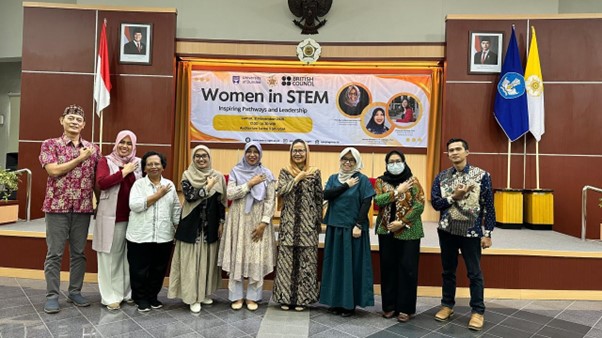


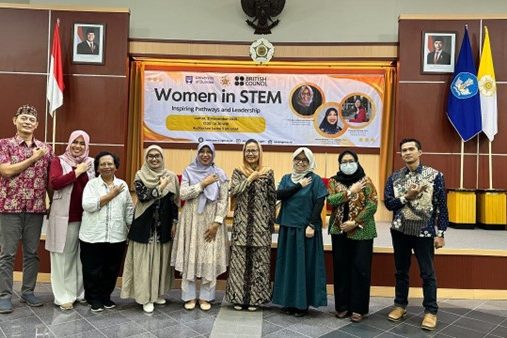
Yogyakarta, 21st November 2025 — The Graduate School of Universitas Gadjah Mada (SPs UGM) hosted an inspiring forum titled “Women in STEM: Inspiring Pathways and Leadership,” a platform designed to strengthen the role of women in science, technology, engineering, and mathematics (STEM). This program was held with a collaboration of SPs UGM, the University of Dundee, and the British Council.
The event, held at the 5th Floor Auditorium of SPs UGM, featured three prominent women scientists who have made significant contributions to research and academic leadership at both national and international levels.
The first session was delivered by Prof. drg. Ika Dewi Ana, M.Kes., Ph.D., a biomaterials expert listed among the Top 2% World Scientists and former Vice Rector for Research at UGM. Through her topic, “From Bench to Policy: Women Scientists Driving Discovery and Institutional Change,” she emphasized how women researchers can play a strategic role in connecting scientific discoveries with institutional policy.
The second presentation featured Rachma Wikandari, S.T.P., M.Biotech., Ph.D., recipient of the L’Oréal–UNESCO For Women in Science Award. In her talk titled “Driving Scientific Excellence: Lessons from an Award-Winning Early-Career Woman in STEM,” she shared her experiences in navigating early research challenges, competing at the global level, and building interdisciplinary scientific networks.
The final session presented Professor Kim Dale, Ph.D., a scientist from the School of Life Sciences, University of Dundee, who discussed “Innovation Across Borders: Empowering Women Scientists in a Connected World.” She highlighted that international collaboration is essential for broadening research impact, particularly for women scientists seeking to engage in global scientific ecosystems.
The Women in STEM program reinforces UGM’s commitment in fostering an inclusive, equitable academic environment that empowers women researchers. SPs UGM hopes this event will serve as a starting point for new collaborations, leadership growth, and the emergence of future generations of women scientists who will drive meaningful change at both national and global levels.
Writer: Arfikah Istari