
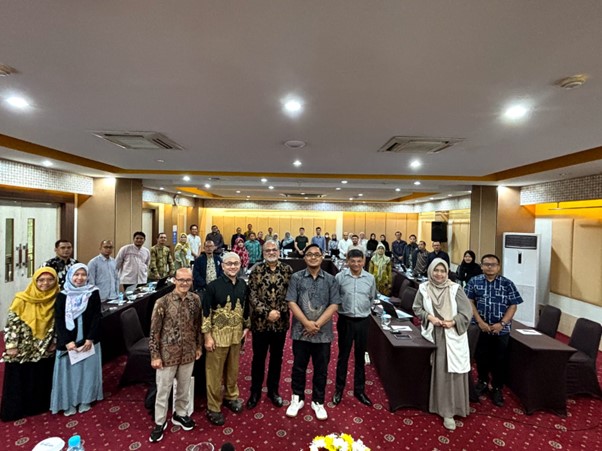


Yogyakarta, 5th December 2025 — TheIslamic Economics and Halal Industry Doctoral Program, Graduate School of Universitas Gadjah Mada (Doctoral Program PIIH SPs UGM) with the Regional Board of the Association of Islamic Economists (IAEI) of the Special Region of Yogyakarta, the Islamic Economics Program, Faculty of Islamic Studies, Universitas Muhammadiyah Yogyakarta (Eksyar UMY), and Universitas Darussalam Gontor, organized the Waqf Research Roundtable Forum 2025 at MM UGM Hotel. The forum aimed to strengthen the contribution of waqf research in addressing the challenges of financing sustainable socio-economic development.
The organization of this forum established from the growing global need for long-term financing sources capable of supporting social services, public facilities, community economic empowerment, and infrastructure development. In this context, waqf offers strategic potential through its perpetual asset nature and its ability to function as both domestic and international private financing. Nevertheless, the optimization of waqf remains hindered by issues of institutional capacity, governance, asset documentation, and innovation in business models—all of which require stronger evidence-based research.
The forum featured a keynote speech by Prof. Habib Ahmed, The Sharjah Chair in Islamic Law and Finance at Durham University (UK), highlighting strategic directions for waqf research development, opportunities for its integration into sustainable development, and the urgent need for institutional reform to enhance the effectiveness of waqf as a public financing instrument. The roundtable discussions then explored waqf management reforms and capacity-building for nazhir, followed by an examination of innovative instruments and productive waqf business models relevant for financing modern development.
UGM and its partners, through this forum, reaffirm their shared commitment in expanding the role of waqf as an adaptive, inclusive, and sustainable development financing instrument. The outcomes of the discussions are expected to strengthen theoretical foundations, empirical evidence, and policy recommendations aligned with global agendas, particularly the contribution of waqf to the Sustainable Development Goals (SDGs)—including poverty alleviation (SDG 1), quality education (SDG 4), inclusive economic growth (SDG 8), innovation and infrastructure (SDG 9), reduced inequalities (SDG 10), sustainable cities (SDG 11), and strategic partnerships (SDG 17).
Writer: Dr. Reni Rosari
Editors: Arni Wistriatun