
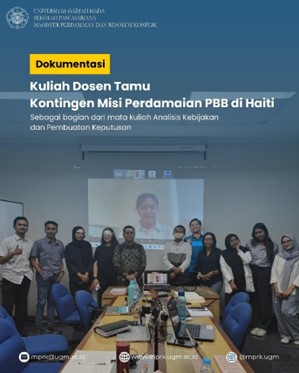

Graduate School (SPs), May 16th – The Peace and Conflict Resolution (MPRK), under the National Resilience Master Program at the Graduate School of Universitas Gadjah Mada (SPs UGM), once again held a guest lecture as part of its commitment to practice-based learning enhancement.
The event, conducted virtually via Zoom Meeting, featured guest speaker Police Commissioner AKBP Asmida R. Siregar, S.I.K., M.IS., Chief of Sub-Directorate I, Directorate of Intelligence and Security (Dit Intelkam) of the East Java Regional Police.
This guest lecture was part of the course Policy Analysis and Decision Making and attended by MPRK students of the 2024/2025 cohort.
The lecture titled was “Citizen and Government Participation in Peacebuilding and Conflict Resolution,” AKBP Asmida highlighted the dual roles played by both civil society and state institutions in preventing, mitigating, and resolving conflicts in various social contexts.
The speaker emphasized the importance of synergy between the government and citizens in building sustainable peace, and how public policy can be designed to support such collaboration. She also discussed the mechanisms for deploying peacekeeping contingents to conflict and post-conflict regions—showcasing Indonesia’s active contribution to global peace efforts.
AKBP Asmida, as a practitioner in the field of security and intelligence, shared valuable field experiences and policy dynamics encountered in conflict resolution and peace operations. Her insights provided students with an in-depth understanding of how state apparatus make strategic decisions in critical situations, and highlighted the importance of humanistic and participatory approaches in conflict resolution.
The two-hour session was highly interactive, featuring a Q&A and discussion that allowed students to further explore issues around security policy and Indonesia’s involvement in international peace missions.
This guest lecture is an essential component of MPRK’s mission to bridge theory and practice and to equip students with real-world perspectives. It is hoped that through such activities, students will enhance their analytical and reflective skills in policy making and in promoting peace at all levels of society.
This activity also supports the implementation of the following Sustainable Development Goals (SDGs): SGD 3: Good Health and Well-being, SGD 4: Quality Education, SGD 16: Peace, Justice, and Strong Institutions, SGD 17: Partnerships for the Goals
Writer: Arni W