
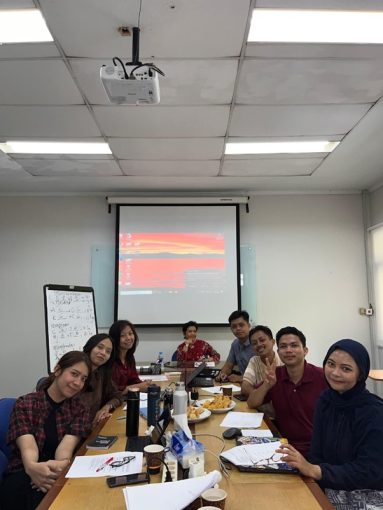

Yogyakarta, November 12th 2025 – The Peace and Conflict Resolution Interest Program (MPRK) at Gadjah Mada University (UGM) opened a space for in-depth academic discourse for its students. Through a thematic lecture titled “Conflict: Fight or Flight?”, MPRK UGM presented Endah Setyowati, an academic from the Humanities Studies Program and a researcher at the Center for Peace Studies and Development (PSPP) at Duta Wacana Christian University (UKDW) in Yogyakarta. This forum was not an ordinary class, but a reflective space to review how conflict is interpreted across various dimensions, from social and cultural perspectives to gender.
Endah Setyowati, in her opening session, encouraged students to deconstruct the common view that has long positioned conflict as a negative phenomenon to be avoided. She emphasized that in many contexts, the response to conflict does not always have to be trapped in the binary of fight or flight. On the contrary, conflict can be interpreted as a golden opportunity for learning, self-development, and opening up space for negotiation. Furthermore, conflict has great potential to drive fundamental social transformation and change if managed with the right perspective.
The discussion then moved deeper, analyzing the anatomy of conflict itself. Endah explained that conflict rarely exists in isolation; it is often rooted in the complexity of unequal distribution of resources, asymmetrical power relations, and information gaps. Cultural values inherent in societal structures play a crucial role in shaping the nature of conflict. Illustrating these theories, Endah used case studies from the Chinese context, inviting participants to observe how power dynamics and social relations operate in real-world settings, shaping the course of conflict and its resolution.
The session then culminated in the urgency of constructive conflict management. Endah cautioned that without proper management, a conflict runs a high risk of escalating into open violence or triggering deep social fragmentation. MPRK students are encouraged to understand conflict on the surface and also hone their analytical skills to identify the deeper roots of the problem. This includes the ability to map the relationships between the parties involved and evaluate resolution strategies that are not only effective but also just, inclusive, and sustainable.
This interdisciplinary thematic lecture emphasizes the commitment of the UGM MPRK in providing learning that goes beyond mere theory. This activity, by involving experts from across campuses and disciplines, is expected to produce graduates who are not merely conflict theorists, but also competent peace practitioners. It is hoped that students will be able to transform the destructive potential of conflict into positive energy that contributes significantly in building just peace, both at the local and global levels.
________________________________________
Author: Mariano Ombo
Editor: Burhanul Aqil