
A small step with great spirit to build a more just and sustainable economy is once again being initiated from Yogyakarta.
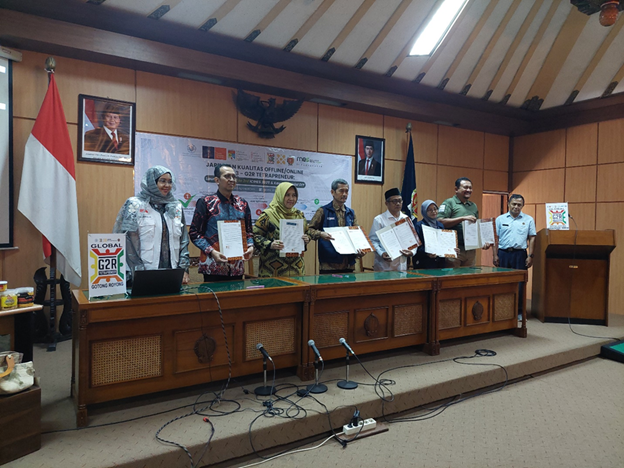
Focus Group Discussion (FGD) themed Offline/Online Tetra 3 G2RT Tetrapreneur Quality Network, held at Wisanggeni Building, Kepatihan Complex, Special Region of Yogyakarta (DIY), was organized by the DIY Office of Community Empowerment, Village Affairs, Population, and Civil Registration (DPMKPP) in collaboration with G2RT Tetrapreneur, the Halal Department of MES Yogyakarta. It was fully supported by the Islamic Economics and Halal Industry Doctoral Program (PD PIIH) at the Graduate School of Universitas Gadjah Mada (UGM) on June 24th 2025.
This event was part of the Road to 3rd ICIHES 2025, a series of initiatives leading up to the 3rd International Conference on Islamic and Halal Economic Studies (ICIHES), to be held on November 4th–5th, 2025.
The conference was more than just a scientific forum; it serves as a collaborative space bridging knowledge, policy, and field practice. It organized by PD PIIH SPs UGM, UGM Faculty of Economics and Business, and Universiti Kebangsaan Malaysia (UKM), the 3rd ICIHES 2025 and also supported by national and international partners, including LEGASI, JAKIM, Kyoto University, Ritsumeikan University, Halal Development Corporation, MES Yogyakarta, Halal Club Yogyakarta, GHI Foundation, and WHITA.
Dr. Reni Rosari, M.B.A., Chief of the Islamic Economics and Halal Industry Doctoral Program at UGM, in her opening remarks, emphasized the importance of uniting the strengths of academics, government, communities, and entrepreneurs to chart a new path for halal economics—one that grows not only in value but also deeply rooted in society. She described the event as a tangible example of how science can serve as a collaborative tool for collective well-being.
The FGD discussion highlighted the G2RT Tetrapreneur model, initiated by Rika Fatimah P.L., Ph.D., as a gotong royong strategy (mutual cooperation) – based approach with four main pillars: product and institutional strengthening, community networking, market access, and policy support. This model provides a concrete approach in building an integrated halal ecosystem in both local and global contexts.
The event, as a mark of shared commitment, also featured the signing of Memorandum of Understanding (MoU) of G2RT and its partners, including PD PIIH SPs UGM, BPD Syariah DIY, LP4H PWM DIY, RRI, and various halal MSMEs. The Declaration of the Yogyakarta Halal Zone was also announced, along with the launch of the Halal Business Plan Competition, MES DIY Halal Ambassador Program, and the Halal Change-Makers—signaling a collective step toward the holistic implementation of a Halalan Thayyiban economy.
This initiative reflects the synergy of scientific spirit, cooperation, and community-centeredness in unified movement. From Yogyakarta, the message is clear: a just, inclusive, and sustainable halal economy is being built—through sincere collaboration and a shared vision for broader well-being.
This activity supports the achievement of the Sustainable Development Goals (SDGs), particularly SDG 1 (No Poverty), SDG 8 (Decent Work and Economic Growth), SDG 9 (Industry, Innovation, and Infrastructure), SDG 11 (Sustainable Cities and Communities), and SDG 17 (Partnerships for the Goals).
Writer: Sitti Nur Amalia Bau
Editors: Arni W