
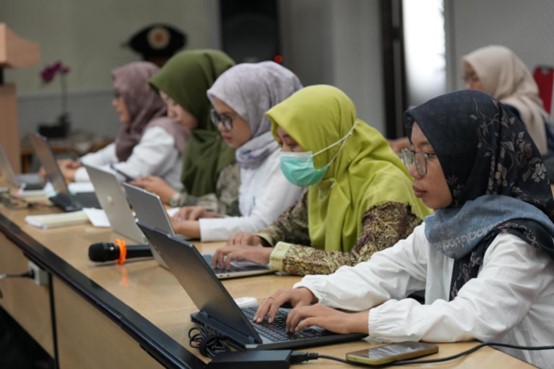
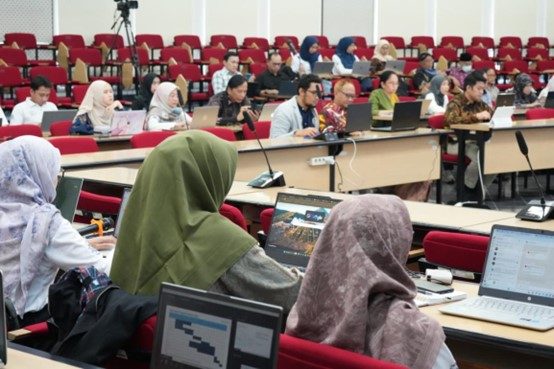
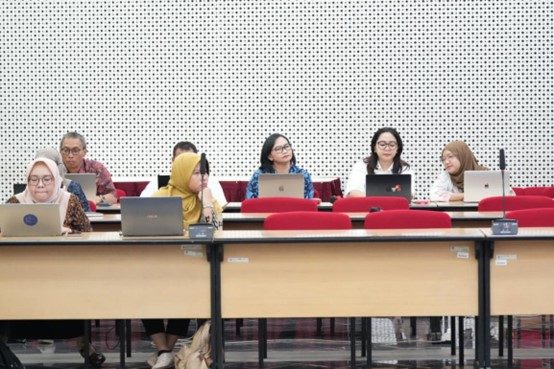
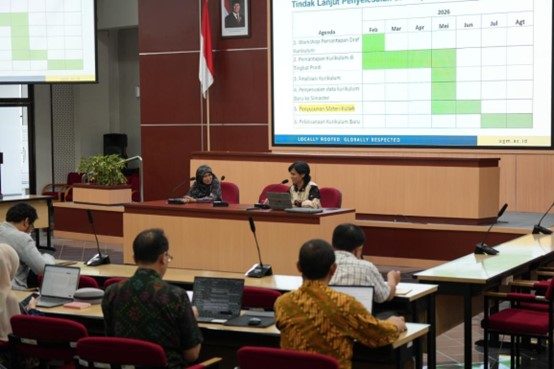
Yogyakarta, February 23rd 2026 – The Graduate School (SPs) of Universitas Gadjah Mada (UGM) continues to make strategic adjustments improving the quality of education and achieving international accreditation. This commitment was established with the “Consolidation Workshop for SPs UGM Curriculum Changes for the 2026/2027 Academic Year,” held at the Auditorium on the 5th Floor, Unit 1 Building of SPs UGM, on Friday (Feb 20th).
The event, attended by the executive board and the chiefs of study programs (Prodi) within the UGM Graduate School, comprehensively discussed adjustments on study loads, the implementation of the European Credit Transfer and Accumulation System (ECTS), and strategies for students’ on-time graduation. The Dean of SPs UGM, Prof. Ir. Siti Malkhamah, M.Sc., Ph.D., officially opened the event and provided strategic directives regarding the guidelines for the new curriculum. She instructed all Chiefs of Study Programs (Kaprodi) to map out study period targets and adjust the Semester Credit System (SKS) loads in alignment with the university’s global vision. In line with this, the Vice Dean for Academic Affairs of SPs UGM, Prof. Dr. Ir. Widyanto Dwi Nugroho, S.Hut., M.Agr., emphasized that this adjustment is a proactive response by SPs UGM to the dynamics of national and university regulations that have been overseen since 2024.
“There are several key policy points in this new curriculum. Among them are the reinforcement of curriculum differentiation for the By Course and By Research pathways, as well as the implementation of ECTS calculations where 1 SKS is equivalent to 45 hours per semester to support international accreditation,” explained Prof. Widyanto.
He also added the policy regarding the requirements to achieve the maximum grade (A) for final projects, which now mandates publication or dissemination in reputable journals. Furthermore, a proportional hierarchy of study loads was emphasized, where Doctoral (S3) programs are designed to have a heavier load compared to Master (S2) programs. During the two presentation sessions by the study programs, a strong commitment in adjusting to international standards was shown. The majority of Master programs—such as the Master’s in Higher Education Management (MMPT), Master’s in Religious and Cross-Cultural Studies, and Master’s in Cultural and Media Studies—have adjusted their study loads to 54 credits, which is equivalent to an average of 97.2 ECTS.
Meanwhile, for Doctoral programs, the study load has been recalibrated to ensure the right depth of research and proportion of theory. The Doctoral Programs in Population Studies, Environmental Science, and Islamic Economy and Halal Industry (PIIH), for example, mapped their curricula within the range of 78 to 86 credits, converting to more than 130 ECTS. Cross-program discussions in the second half of the workshop produced important formulations regarding technical guidelines for students. All programs at SPs UGM expressed their strong commitment in encouraging students to graduate on time. Concrete steps taken include facilitating the assignment of academic supervisors from the beginning of the second semester, followed by the execution of thesis seminars no later than the end of the second semester or the beginning of the third semester.
As a follow-up plan, SPs UGM will facilitate further curriculum finalization, including synchronizing the equalization of curricula among Master programs such as Biomedical Engineering and Biotechnology, as well as detailing thesis and dissertation assessment forms in accordance with the mandates of UGM Rector Regulations Number 23 of 2024 and Number 19 of 2025. Fast Track programs (Undergraduate to Master and Master to Doctorate) are also guaranteed to continue running without altering the essence of the existing basic curriculum.
Author: Berlian Belasuni