
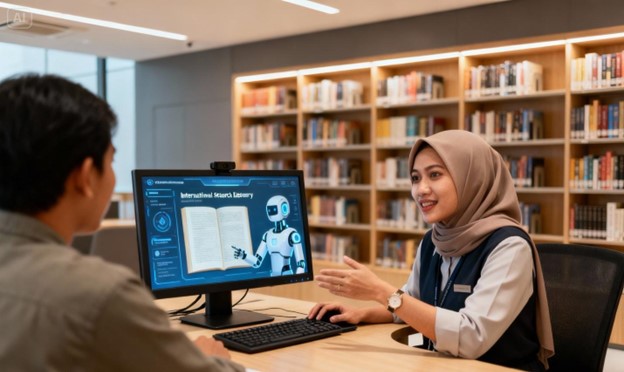
Yogyakarta, 15th January 2026 — The rapid development of Artificial Intelligence (AI) technology has disrupted various sectors, including libraries, which are closely linked to the field of education, particularly higher education. The focus on universities is considered crucial, as campuses serve as epicenters of knowledge production and innovation. Today, university libraries no longer function merely as repositories of collections and information resources, it has evolved into data-driven knowledge management centers.
The presence of artificial intelligence offers greater efficiency in information retrieval, collection management, and virtual reference services. The implications of digital transformation in higher education have consequently posed new challenges for academic librarians, particularly in enhancing their competencies to manage research big data and to safeguard academic integrity amid the widespread use of generative AI by the academic community. In response to this phenomenon, a research team led by Milda Longgeita Pinem, S.Sos., MA, Ph.D., from the Information and Library Management Program (MIP), Universitas Gadjah Mada (UGM), conducted an in-depth study on artificial intelligence literacy among university librarians in Indonesia.
The study was conducted in 2025 and involved surveys and in-depth interviews with librarians from various public and private universities across Indonesia. The aspects examined included fundamental understanding of AI concepts, the use of AI tools in daily professional tasks, as well as perceptions of algorithmic bias, ethical issues in AI usage, and data privacy.
“We must acknowledge that there is still a considerable competency gap in the field. Younger librarians, or so-called ‘digital natives,’ may adapt more quickly to AI tools, but for the more senior generation, this presents a distinct challenge. Moreover, our educational backgrounds vary; not everyone has a strong foundation in information technology. Therefore, structured AI training—not merely brief seminars—is urgently needed so that no one is left behind,” said one informant.
The findings of this research are expected to serve as a foundation for the development of a national librarianship training curriculum, as well as for the creation of lifelong learning modules for information professionals. The exploration of artificial intelligence literacy among university librarians in Indonesia, MIP UGM hopes to help bridge the digital divide and to prepare an adaptive, intelligent, and human-centered Indonesian library ecosystem amid the rapid advancement of technology.
Author: Ade RS
Editor: Asti Rahmaningrum
Photo: DreaminaAI