
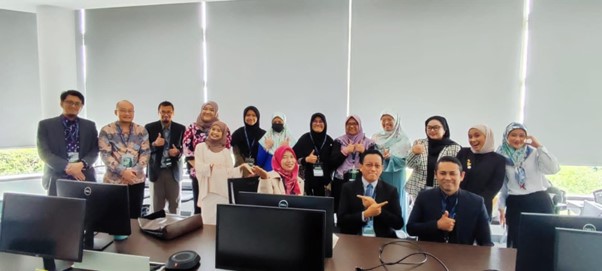
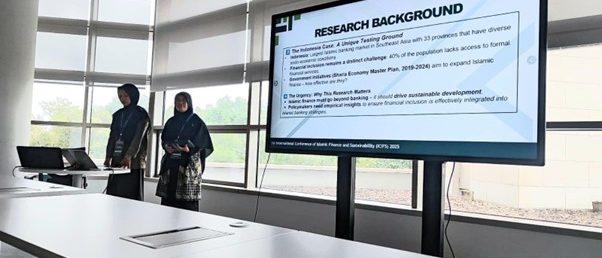
Maddani Akhsa Nulyani and Nurfitri Harkunti Kemala Hayati, two students majoring in Islamic Economics (Ekis) at the Department of Religious and Cross-Cultural Studies (ALB), Postgraduate School (SPs) UGM, participated in The 1st International Conference of Islamic Finance and Sustainability (ICIFS) held at the Sultan Haji Hassanal Bolkiah Institute of Islamic Studies (BKISHHB) in Bandar Seri Begawan, Brunei Darussalam, from February 4th to 6th, 2025.
This international conference, organized by the School of Business and Economics at the Universiti Brunei Darussalam, explored the strategic role of Islamic finance in driving sustainable development and addressing current global challenges. It also discussed the potential of Islamic financial products in facing global economic uncertainties.
The conference was attended by researchers, academics (both students and lecturers), and practitioners of Islamic finance from around the world. Various international academic experts and scholars in the field of Islamic finance, such as Prof. Dr. M. Kabir Hassan from the University of New Orleans, Prof. Dr. Mansor Ibrahim from INCEIF University Malaysia, Prof. Dr. M. Ishaq Bhatti from Universiti Brunei Darussalam, Assoc. Prof. Dr. Hakimah Yaacob from Universiti Islam Sultan Sharif Ali, Assoc. Prof. Dr. Selamah Binti Maamor, and Assoc. Prof. Dr. Norazlina Abd. Wahab from Universiti Utara Malaysia, actively participated in panel discussions, exploring how to improve the quality of research in Islamic finance to contribute to addressing real-world challenges and promoting sustainability and collaborative innovation.
During the 1st ICIFS, Maddani and Nurfitri had the opportunity to present their paper titled “Islamic Banking, Financial Inclusion, and Human Development: Catalyst for Sustainable Development Goals.” This paper discusses the potential of Islamic banking as an intermediary institution that can enhance financial inclusion, thereby contributing to the improvement of human development indices in Indonesia. Using data from the Financial Services Authority on Islamic financing distribution and financial inclusion, as well as data from the Central Statistics Agency on human development indices, they found that third-party funds and the size of Islamic banks have significantly influenced financial inclusion, which in turn impacts human development indices.
Better access to financial services enables communities to invest in education, health, and business opportunities, thereby improving quality of life and reducing inequality. Furthermore, the findings of this research recommend that, in order to truly contribute to human development, Islamic financial institutions should adopt more inclusive and sustainable financing strategies and ensure that their financial capacities provide real benefits for societal well-being.
Islamic finance is not merely an economic system but also a means to achieve justice, empowerment, and social progress. In striving for sustainable development, we must remember that financial inclusion is not a privilege, but a right that should be accessible to all segments of society. This article received positive feedback from the chairperson, Dr. Surianna binti Hj Talip, a lecturer at Universiti Sultan Sharif Ali Brunei Darussalam.
In addition to the panel discussions and parallel sessions, the School of Business and Economics at Universiti Brunei Darussalam also held a research workshop aimed at providing a specific overview of the fundamental basis for research in Islamic finance for graduate and doctoral students conducting research in this field.
This activity also serves as the application of SDG Goal 4 on Quality Education and Goal 17 on Partnerships for the Goals.
Authors: Nur Fitri Harkunti / Arni Wistriatun
Editor: Ana Anggraini